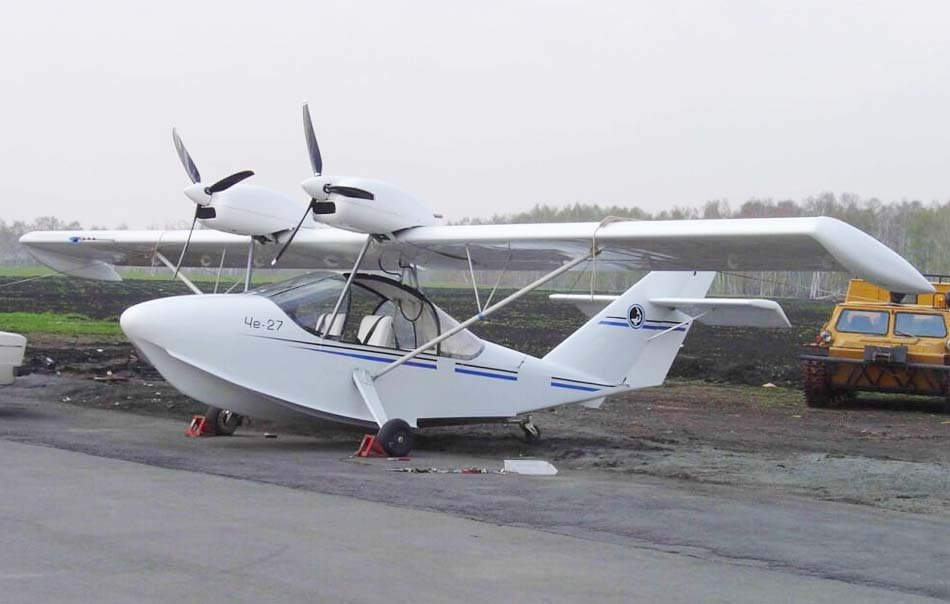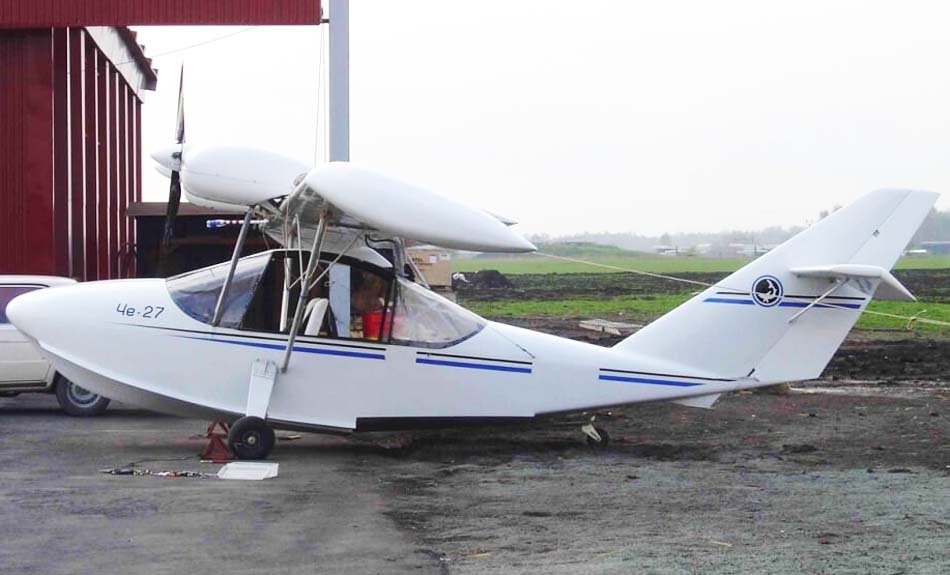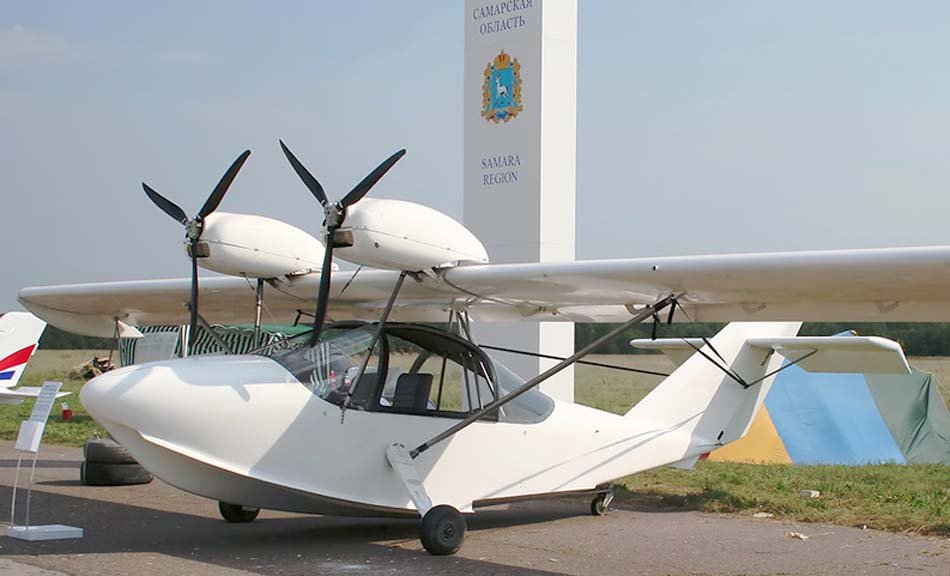
The light amphibian Che-27 is a twin-engine, five-seater seaplane that was built in Russia and underwent testing in 2003. It was developed and manufactured in Samara under the leadership of chief designer Boris Valentinovich Chernov. Since 2008, it has been produced by LLC “Gidrosamolet” in St. Petersburg, with Konstantin Dorgovtsov as its general director.
LLC “Gidrosamolet” offered the Che-27 in three main modifications: the Che-27A, the base configuration with two Rotax 912ULS engines (2×100 hp), priced at 144 thousand euros; the Che-27B, with increased fuel capacity, costing 174 thousand euros; and the Che-27V, featuring more powerful Rotax 914 (2×115 hp) or Jabiru 3300 (2×120 hp) engines, for 186 thousand euros.
This aircraft is a further development of the Che-25M. Unlike the Che-25M, it features a slightly widened fuselage with improved contours. In terms of characteristics, it is practically indistinguishable from the Che-25M.
Versatile Operational Capabilities
Aircraft designer Boris Chernov positioned this seaplane as multi-purpose, intended for operation in regions with a high concentration of water bodies, as well as in areas near the Arctic Circle, the polar regions, and the Far North.
The equipment package designed for the Che-27 allows it to take off and land year-round in any weather: from water in its amphibious configuration, from ground using its landing gear, or on skis during the winter season.
The aircraft’s ability to take off from the ground is due to its retractable landing gear, which does not hinder the seaplane from alighting on water surfaces deeper than 0.5 meters and longer than 250 meters.
Furthermore, the presence of a gently sloping dry shore with a solid base allows the aircraft, by deploying its landing gear, to taxi onto the shore independently. After unloading and taking on cargo, it can re-enter the water and take off even with waves up to 0.5 meters.
The design of the Che-27 amphibian seaplane allows for the installation of a fourth-class navigation complex, as per customer requirements. This enables the aircraft to be used in the national economy, performing the full range of tasks typical of aviation.
Innovative Design and Applications
The tasks for which the Che-27 seaplane was created include passenger and cargo transport, training missions, emergency medical assistance, and patrolling of oil and gas pipelines and power lines to detect malfunctions. It also serves for patrolling forests during fire threats, performing environmental tasks over water bodies, fishery surveillance, supporting reindeer herding organizations, patrolling nature reserves, and conducting special rescue operations.
The Che-27 seaplane’s full cockpit glazing provides the pilot and passengers with unrestricted 360-degree visual observation, significantly enhancing situational awareness and safety.
The Che-27A modification is capable, with a 500 kg payload, of maintaining horizontal flight for a long time without descending when the engine throttle is set to idle. The aircraft possesses excellent aerodynamic qualities and, in case of both engines failing, can continue a gliding flight to search for a suitable landing site. Landing can be performed either on the chassis or on the hull of the boat.
For emergency water landings, a removable transom is provided for transporting the aircraft to shore, allowing an outboard motor of 5 to 8 hp to be attached. The seaplane’s boat hull is made of fiberglass, making it resistant to corrosion in fresh and saltwater, which ensures a long service life.
This modification of the seaplane is mainly equipped with a single control post, but for training tasks or long flights, a second control post can be installed upon customer request.
An unusual feature of the Che-27 is its disassemblable design, which allows the owner to independently remove the wings and load the entire seaplane onto a car trailer for transport. This eliminates the need to obtain approval from aviation services for air transport of the aircraft.
As of August 2012, the register of individual aircraft of AON Russia listed one Che-27 (RA-1012G), as well as one modified Che-27M2.
Technical Specifications
| Модификация | Че-27А |
| Размах крыла, м | 12. 80 |
| Длина самолета,м | 7.89 |
| Высота самолета,м | 2.68 |
| Площадь крыла,м2 | 15.90 |
| Пустого | 650 |
| Максимальная взлетная | 1150 |
| Топливо, л | 130 |
| Тип двигателя | 2 ПД Rotax 912 |
| Мощность, л.с. + квт | 2 х 100 |
| Максимальная скорость, км/ч | 210 |
| Крейсерская скорость, км/ч | 160 |
| Практическая дальность, км | 900 |
| Скороподъемность, м/мин | 300 |
| Практический потолок, м | 3000 |
| Экипаж, чел | 1 |
| Полезная нагрузка: | до 4 пассажиров и до 500 кг груза |
Image and diagram gallery of the Che-27