The Legacy of the Challenger 300
Creating a successor to the Challenger 300 was no easy feat. Debuting in 2003, this model quickly became a class favorite, snatching the title from the Gulfstream II thanks to its generous thrust-to-weight ratio, large wing, and agility. The Challenger 300 was not only more modern but also more affordable, matching its competitor in other parameters.
It offered transcontinental range, a flat floor, an eight-passenger cabin, in-flight access to the baggage compartment, and ‘rock-solid’ reliability. With its signature oval windows and a premium price tag, everyone might have believed it originated from Savannah, Georgia, rather than Montreal.
Sales immediately broke records as competition was largely theoretical at the time. The closest competitor in cabin size, the Gulfstream G200, was inferior in flight performance characteristics. The Hawker 4000 could have been a potential contender in performance, but a decade of ‘teething problems’ effectively took it out of the race. As for the Dassault Falcon 50EX, the Canadian aircraft surpassed it in terms of operating costs.
Overall, for almost a decade, the Challenger 300 held supremacy in the midsize and super-midsize classes, as no other aircraft could offer such a combination of cabin comfort, flight performance, operational economy, and reliability. Customers voted with their wallets: by mid-2014, Bombardier had sold and delivered over 450 Challenger 300 aircraft.
Introducing the Challenger 350
However, during this time, the market changed significantly, and the super-midsize segment became quite crowded. Significantly more high-tech models appeared, such as the Embraer Legacy 500, Gulfstream G280, as well as heavily upgraded Cessna Citation Sovereign+ and Citation X.
Given such serious competition, the Challenger 300 could no longer rely on unconditional leadership. Soberly assessing the situation, Bombardier executives concluded that a full replacement program for the Challenger 300 was not worth launching. Instead, they decided to implement the solutions requested by operators.
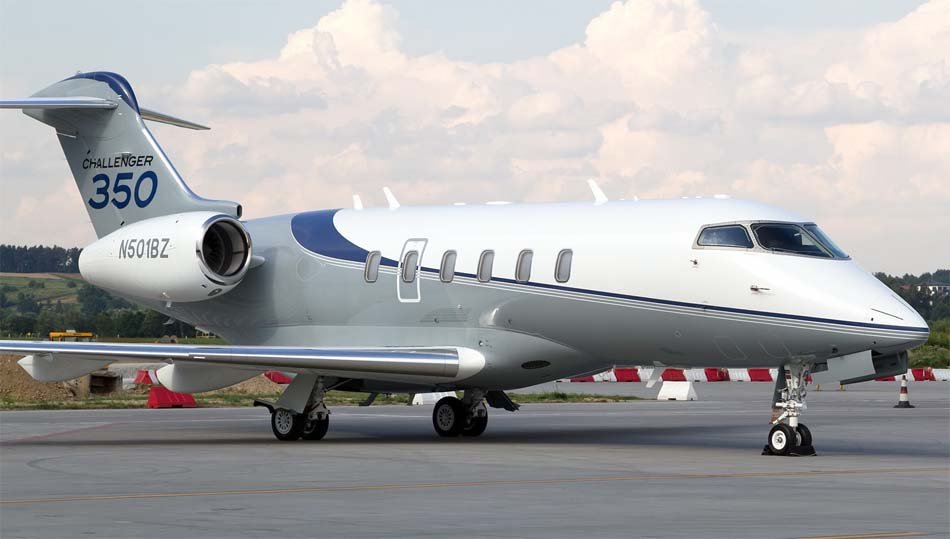
Engineers transformed the Challenger 300 into a new model, featuring upgraded avionics, more powerful engines, more efficient winglets, and pleasant cabin equipment innovations. The maximum takeoff weight increased by 794 kg, and other weight parameters were also brought closer to customer wishes. The result was the Challenger 350, a model surpassing the original in almost every aspect, yet differing in price by only $1.68 million. The aircraft’s first flight took place on March 2, 2013.
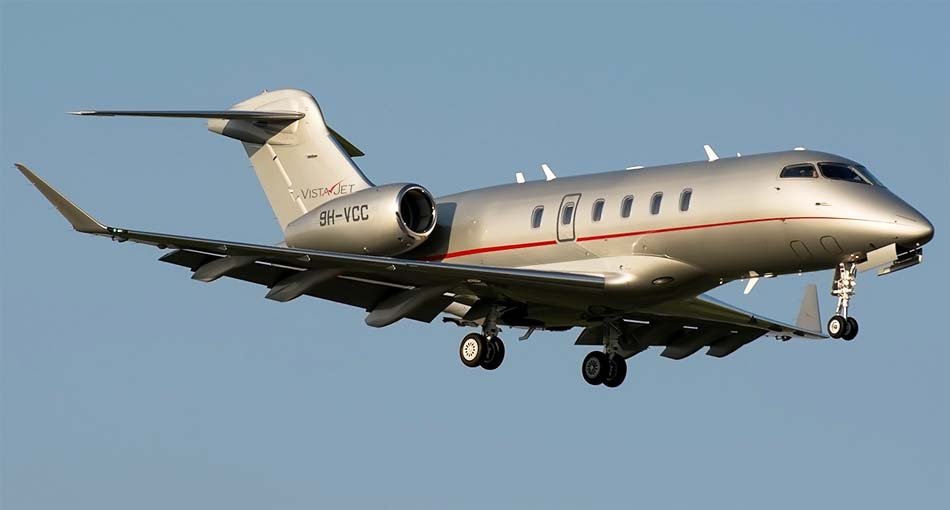
The launch customer for the new model was fractional ownership operator NetJets, which placed an order for 75 aircraft in the exclusive Signature Series, totaling $7.3 billion. Unsurprisingly, NetJets’ requirements greatly influenced the aircraft’s characteristics and cabin configuration. In this form, the Challenger 350 also proved attractive to other major operators, with VistaJet and Flexjet each placing orders for 20 aircraft.
Advanced Avionics and Interior Comfort
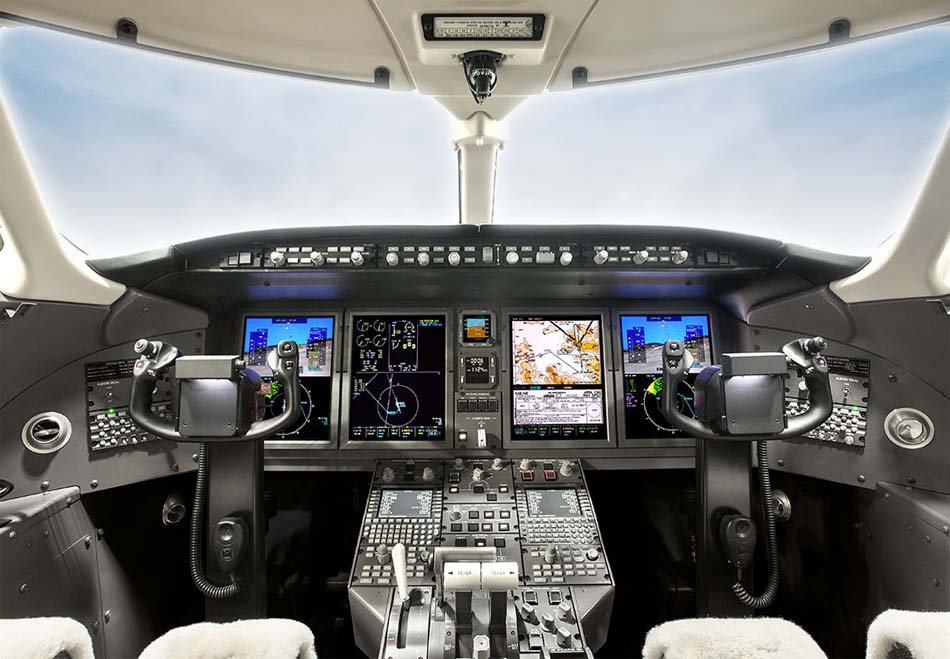
The main areas of modernization, in addition to the increased takeoff weight, included engine replacement, the upgrade of the Rockwell Collins Pro Line 21 Advanced avionics, and the renewal of the passenger cabin interior.
A synthetic vision system (SVS) provides a complete 3D picture of the external landscape; a dual inertial reference system allows the aircraft to automatically determine its position, speed, and orientation in space. Furthermore, a unique, automatically updated database, along with electronic charts and technical documentation, ensure fully ‘paperless’ flights. According to the developers, all these features combined should reduce pilot workload and enhance their situational awareness.
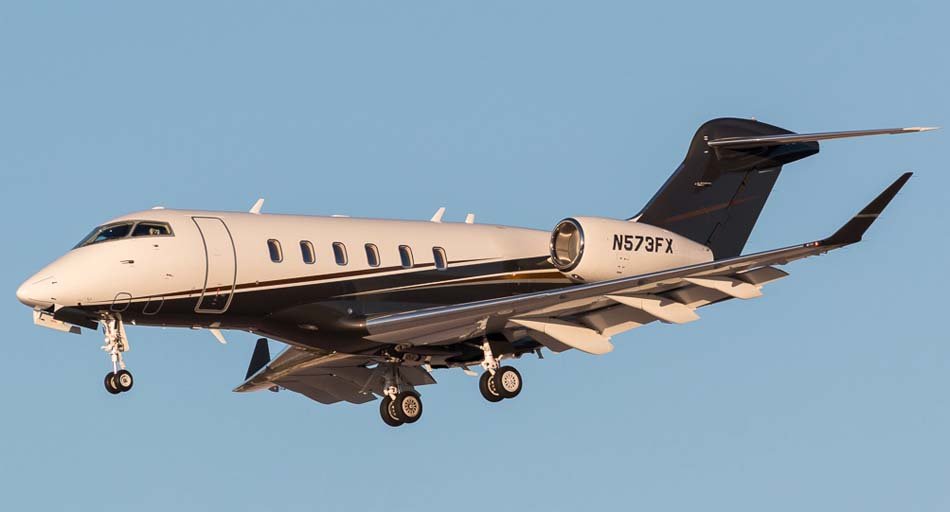
One of the most obvious modifications distinguishing the Challenger 350 from its predecessor is the winglets. Positioned at a greater angle to the wing plane than those on the Challenger 300, they more effectively manage drag and, additionally, extend the wing by 158 cm. Thanks to them, the aircraft climbs faster despite the increased weight. Otherwise, the wing’s structure and mechanization remain unchanged. The same applies to the fuselage, with the exception of the windows, which are 5 cm longer and now let in 12% more light. While seemingly not much, the difference is noticeable to the naked eye!
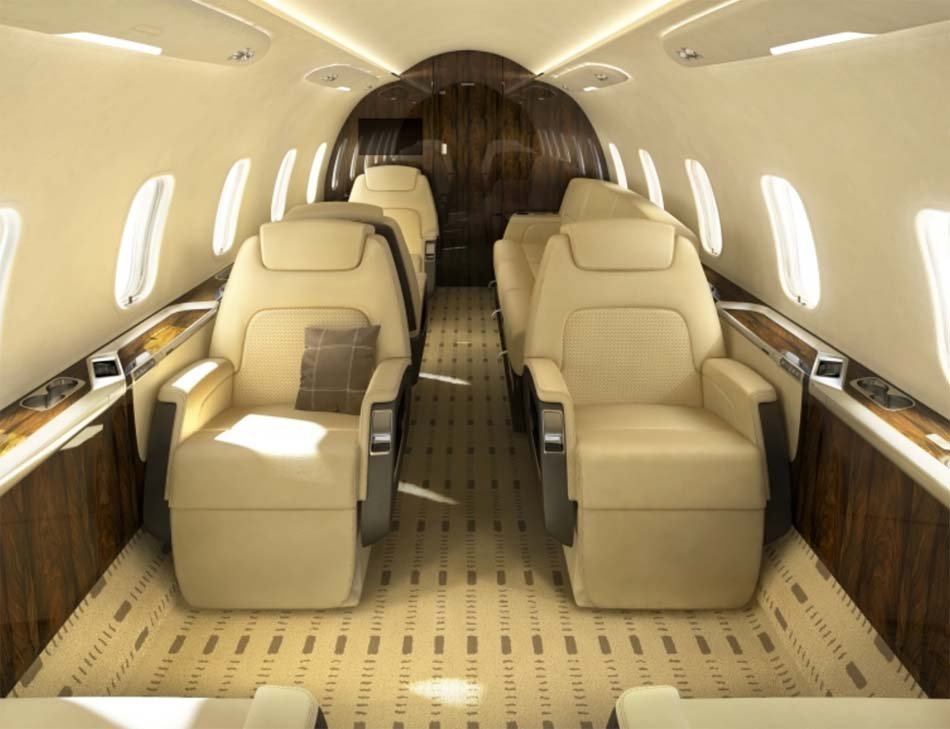
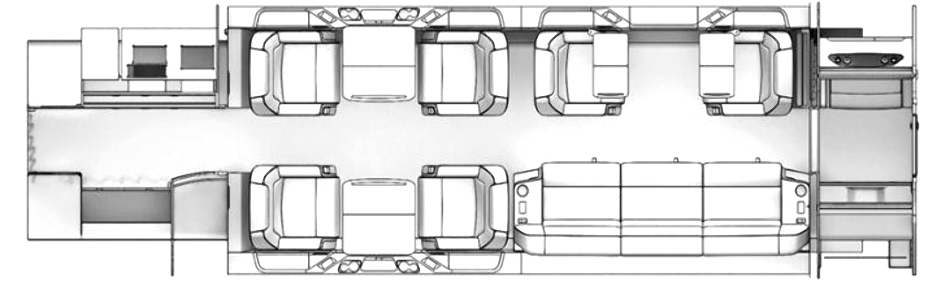
In its standard configuration, the cabin is designed for eight passengers in two club sections, or nine if one agrees to spend the flight in a specially equipped lavatory seat. As an option, a three-seat sofa can be installed in the rear of the cabin instead of two individual seats. Fold-out tables measuring 60 x 63 cm separate pairs of seats. The cabin floor length is 503 cm.
As mentioned, thanks to the enlarged windows, the cabin is noticeably brighter than in the previous version, visually making it feel more spacious. The Lufthansa Technik-produced Cabin Management System (CMS) includes an entertainment center with two 22-inch monitors displaying a moving 3D flight map, eight headsets with active noise cancellation, audio speakers, a Blu-ray player, HDMI, and ports for USB and iPhone/iPad. Standard cabin equipment also includes four power outlets and CMS touchscreens at each seat. Separate buttons are also provided for activating overhead lights, adjusting volume, and calling a flight attendant. Satellite telephony options include Iridium as standard and Inmarsat SwiftBroadband as an option.
Passengers enter the cabin via an air-stair equipped with single-sided handrails and step lighting. The door features an electric motor to ease closing and a screen to reduce noise. To the starboard side is the galley unit, and opposite it, a wardrobe. Standard galley equipment includes a coffee maker (replaced by a hot beverage dispensing machine on NetJets aircraft), a microwave oven, ice and waste containers, and compartments for storing food and drinks. The galley unit pleases flight attendants with its full-size working surface and impact-resistant finish. A sink with running water is offered as an option.
A lavatory is located in the aft fuselage. The bio-toilet is serviced externally. In addition to a sink, standard cabinets, a mirror, etc., the entrance to the 3 m³ baggage compartment is also located here. This compartment can also be accessed from outside the aircraft via a hatch located under the left engine pylon. Optional noise insulation reduces noise levels by 2-3 dB but adds an extra 90 kg of weight.
The aircraft received new power units in the form of two Honeywell HTF7350 turbofan engines. With eight passengers on board, these engines can achieve a cruising speed of 0.8 Mach with 3200 Nm of torque and provide a maximum range of 5926 km, which is 250 km greater than the Bombardier Challenger 300. The engine thrust also increased by 7.3% compared to its predecessor’s engines.
Technical Specifications
| Modification | Challenger 350 |
| Wingspan, m | 21.00 |
| Aircraft length, m | 20.90 |
| Aircraft height, m | 6.10 |
| Wing area, m2 | 48.50 |
| Empty weight | 11249 |
| Maximum takeoff weight | 18484 |
| Fuel | 6418 |
| Engine type | 2 Turbofan Honeywell HTF7350 |
| Thrust, kN | 2 x 33.0 |
| Maximum cruising speed, km/h | 870 |
| Normal cruising speed, km/h | 849 |
| Practical range, km | 5926 |
| Service ceiling, m | 13716 |
| Crew | 2+1 |
| Payload | 8-9 passengers |
Image gallery of the Bombardier Challenger 350