In 1921, the 10th Congress of the Russian Communist Party proclaimed the transition from “War Communism” to NEP – the New Economic Policy (1921-1929). For its development, NEP required decentralization of economic management. In August 1921, the Council of Labor and Defense (STO) adopted a resolution to reorganize the existing system of “glavki,” where all enterprises of a single industry were subordinated to a unified central management body.
The number of sectoral glavki was reduced; only large industry and basic economic sectors remained in state hands. Under NEP conditions, the management structure also changed significantly, greatly affecting the aviation industry. By resolution of the STO dated January 28, 1925, the aviation department of Glavvoenprom was abolished, and in its place, the State Aviation Industry Trust (Aviatreste) was created, possessing broad independence.
Initially, it included 11 subordinate enterprises. The Trust was under the jurisdiction of the Main Directorate of the Metal Industry of the VSNKh of the USSR. Subordinate enterprises were deprived of legal entity rights, had no balance sheets or reporting, and could not enter the market. However, operationally, the management of all factory activities was carried out by directors, appointed since 1921 instead of managers.
Soviet Aviation Industry Reorganizations
Aviatreste itself was managed by a board consisting of a chairman and four members, appointed by the VSNKh of the USSR in agreement with the Central Committee of the trade union. The chairman of the Aviatreste board was approved by the Revolutionary Military Council of the USSR (the modern-day Ministry of Defense). The Aviatreste board was granted rights to purchase and sell property, lease buildings, issue and accept bills of exchange, and participate in syndicates and various trade and industrial associations.
Powers were also given to conduct currency and credit operations, and open offices and agencies. Aviatreste’s main product was military; it could freely sell civilian products on both domestic and foreign markets. The creation of Aviatreste contributed to the transformation of aircraft construction into an independent industrial sector.
The history of aviation industry management bodies in the early 1930s is also characterized by constant and continuous reorganizations. Aviatreste, created in 1925, was transformed on March 3, 1930, into the All-Union Association of the Aviation Industry of the VSNKh (VAO), which on July 28 of the same year was re-subordinated to the People’s Commissariat for Military and Naval Affairs (NKVМ).
The VAO was subordinate to seven aircraft manufacturing, four engine manufacturing, six repair, five auxiliary, and three experimental plants. The formation of the VAO was only part of a broad plan for a fundamental change in the system of national economic management, providing for the breakup of the VSNKh of the USSR as a universal People’s Commissariat of Industry and the transition to sectoral management of the national economy.
By a resolution dated January 5, 1932, the Central Executive Committee of the USSR abolished the VSNKh of the USSR and formed on its basis the People’s Commissariats of Heavy, Light, and Forest Industries. Then, on December 7, 1934, the VAO was transformed into the Main Directorate of the Aviation Industry of the VSNKh – Glavaviaprom (GUAP), meaning the military aviation industry once again returned from the military department to the economic department.
In 1934, Glavaviaprom included 15 numbered factories, the KHAZOS experimental machine-building plant, and the KhAI and TsIAM institutes. On January 5, GUAP was transferred to the jurisdiction of the People’s Commissariat of Heavy Industry (NKTP), where it existed until 1936. However, by 1934, the NKVМ no longer controlled Glavaviaprom; GUAP was directly subordinate to Narkomtyazhprom.
Aeroflot’s Growth and the Demand for New Aircraft
Aeroflot’s rapid development occurred in the 1930s when, thanks to the industrialization of our country and the rise of science and culture, a domestic aviation industry was created. Dozens of domestic and international routes were opened, and the widespread use of aircraft in several industries and in agriculture began. By the early 1940s, Soviet civil aviation firmly occupied one of the leading places in the world in passenger and cargo transportation and in its application in the national economy.
To successfully solve the tasks set for Soviet Civil Aviation during the pre-war five-year plans, new, more perfect forms of organization were required. In this regard, on February 23, 1930, the Council for Civil Aviation was abolished, and its functions were transferred to the Main Inspection. For further centralization of the management of Soviet Civil Aviation activities, on October 29, 1930, by resolution of the SNK of the USSR, the All-Union Association of the Civil Air Fleet (VO GVF) was formed under the STO (Dobrolet and the Main Inspection were abolished).
On February 25, 1932, the VO GVF was transformed into the Main Directorate of the Civil Air Fleet (GUGVF) under the SNK of the USSR, which was named “Aeroflot.” Subordinate to the GUGVF were self-supporting trusts such as “Transaviatsiya,” “Selkhozaviatsiya,” and others, which were liquidated on May 19, 1934, by resolution of the SNK of the USSR. In their place, 12 territorial administrations of Soviet Civil Aviation were formed.
Agricultural aviation was transferred to the GUGVF from the Narkomzem of the USSR (November 1932) and sanitary aviation from the Narkomzdrav of the USSR (November 1937). In 1932, uniforms and insignia were introduced for Soviet Civil Aviation personnel. In its further development, Soviet air transport had to overcome many difficulties, mainly related to its technical base.
In the mid-1930s, the Union’s air routes were flown by few and already outdated aircraft like the K-5, ANT-9, and P-5, which were inferior to their world counterparts in all parameters. New aviation technology was required. The Narkomtyazhprom industry practically did not engage in the construction of civil aircraft at that time. GUGVF had small factories and research institutes, but these, naturally, could not radically solve the problems of air transport.
The BB-2 (TsKB-30) Passenger Variant Project
Taking this factor into account, on May 19, 1932, the NII VVS (Air Force Research Institute) approved the “Regulation on State Tests of Experimental and Licensed Aircraft of Soviet Production.” For the first time, it stipulated: “The comprehensive development and encouragement of designing new models, both in number and quality, must, at the same time, ensure the presence and maintenance of a minimum number of types in serial production. For this purpose, when designing each military and civil aircraft, one must proceed from the requirements presented to the main military types of aviation established by the RVS of the USSR.”
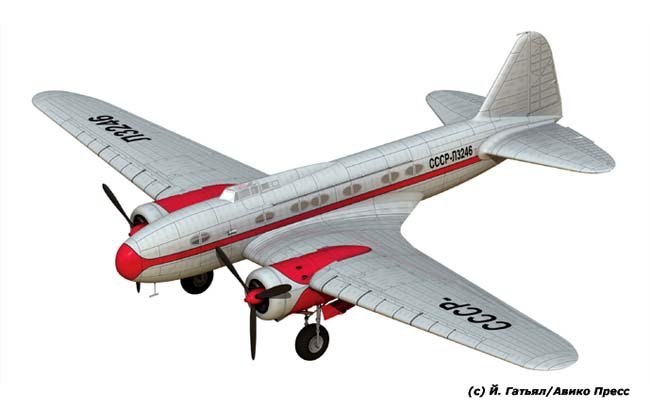
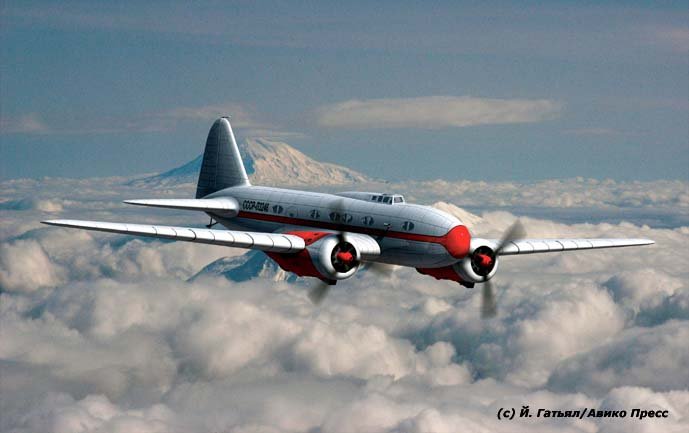
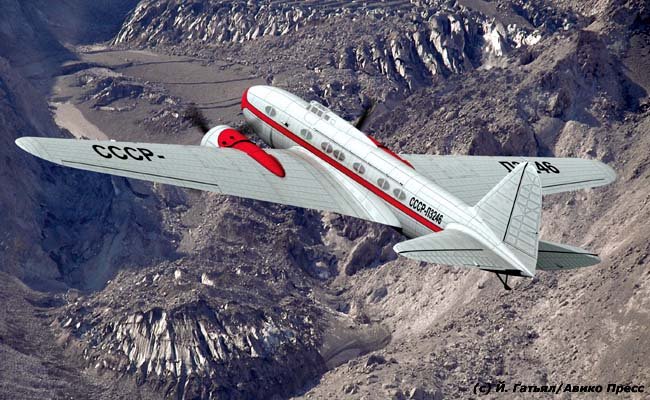
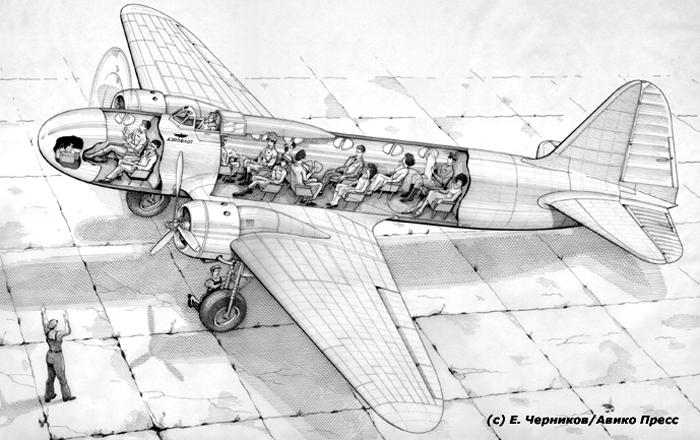
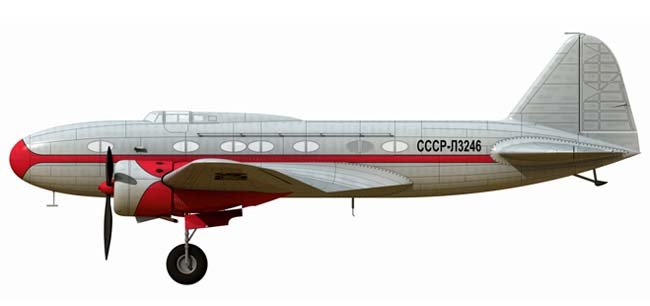
Based on this and considering Aeroflot’s need for new aviation equipment, in 1935 S. V. Ilyushin proactively proposed a passenger variant of the BB-2 bomber (TsKB-30). The project was worked out in a first approximation, as evidenced by discovered documents. The full text of a memorandum, signed by the head of brigade No. 3, S. V. Ilyushin, is provided below. The oldest employee of the Design Bureau, E. S. Chernikov, restored the appearance and layout of this interesting aircraft from old tracings. The materials were first published in the almanac “Nashi Krylya” (Our Wings).
The layout and design of the BB-2 military aircraft were conceived so that, without modifications, the aircraft could be converted (not rebuilt) from a military variant to a passenger one. The entire structure of the aircraft, when transitioning from a military variant to a civilian one and vice versa, remained unchanged, thus the production process remained identical for both variants. The design provided for the installation of two types of engines: “Gnome-Rhône” K-14 and “Wright-Cyclone” F-3.
The aircraft data with the specified engines were as follows: crew: 2; passengers: 12; maximum speed at 3000-4000 m: 350-375 km/h (Gnome-Rhône K-14) or 385-410 km/h (Wright-Cyclone F-3); ceiling: 8000 m (Gnome-Rhône K-14) or 6500 m (Wright-Cyclone F-3); landing speed at takeoff: 96 km/h; landing speed with burnt fuel: 91 km/h; normal range: 850 km; range with overload: 1500 km.
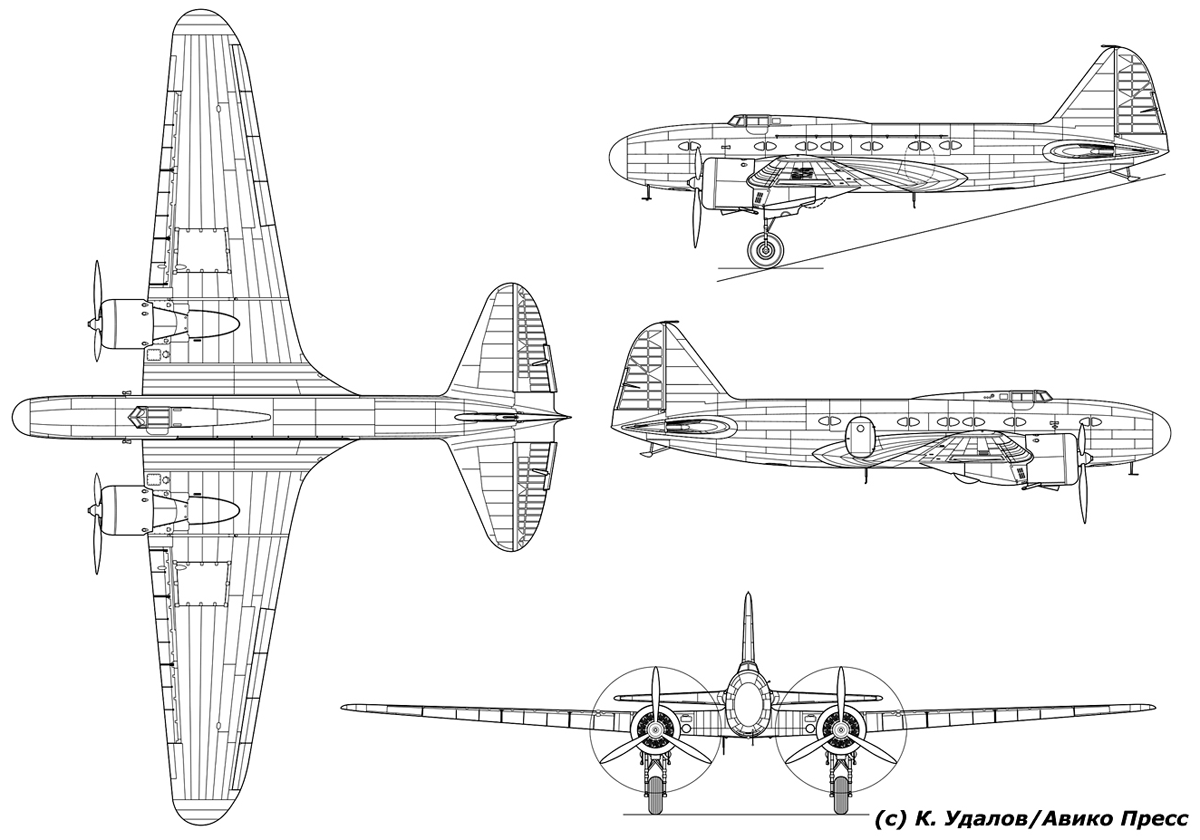
A brief technical description of the BB-2-2 “Gnome-Rhône” K-14 aircraft is attached. The BB-2-2 K-14 aircraft is a low-wing monoplane of all-metal construction. The fuselage for the first flight prototype was to be entirely wooden, with a frame consisting of stringers, spars, and transverse glued plywood bulkheads. The skin was of plywood veneer.
The second flight prototype would have an all-metal fuselage entirely made of super-aluminum with rigid skinning. The empennage was all-metal – duralumin. The wing consisted of five parts. The central section – the center-plane – was rigidly attached to the fuselage and formed a single unit with it. The size of the center-plane was such that it could, together with the fuselage, fit within railway dimensions. This requirement for mandatory railway transport necessitated cutting the wing in one more place, as otherwise all engine equipment and landing gear would be with the console, thus creating all the inconveniences associated with aircraft assembly and disassembly.
Thus, the wing consisted of a central part, two adjacent sections to which the landing gear and engine installation were attached, and two consoles. The wing comprised two spars of hardened chromoly steel of truss type. The wing frame consisted of a set of equally stressed ribs and longitudinal stringers. At the joints of the consoles and engine compartments to the center-plane, the rigid skinning would be joined to work across the entire span. The skinning was smooth with flush riveting. Ribs and skinning were made of super-duralumin. Flaps were located between the longitudinal axis of the aircraft and the inner end of the aileron to reduce landing speed. The wing profile was CLARC Y 15, thickness at the root 16%, at the tip 10%. Ailerons were not slotted. Relief from hinge moments was achieved using flettners.
The fuselage consisted of five longitudinal spars, a system of stringers, and a transverse set of glued plywood and wooden frames. The fuselage covering was veneer of 4, 5, and 6 layers. The fin formed a single unit with the fuselage. The landing gear was retractable backward along the airflow. Retraction and extension of the landing gear were performed by means of a hydraulic system. The retraction mechanism consisted of a cylinder and a rod directly acting on a lever, whose axis of rotation coincided with the axis of rotation of the landing gear. For a forward impact, the force was absorbed by a strut going from the main landing gear frame to the truss basket of the wing.
These struts had sliders which, in the upper retracted and lower extended positions, had gun-type locks that could be opened and closed by mechanical transmission. Emergency landing gear extension was provided. In case the main hydraulic landing gear release mechanism failed, a mechanism consisting of a drum with a rotating handle in the pilot’s cockpit and cables passing through a system of rollers would operate the landing gear release. The damping system was oleo-pneumatic. The wheel was a braking type, 900×200. Provisions were made to allow replacement of the front landing gear frame and struts for a 1100×250 wheel in case of possible future large overloads of the aircraft.
The “Gnome-Rhône” K-14 engines were placed on the wings. The propeller thrust axis was located 75 mm below the wing chord. The engine was cowled with a NACA cowling. Oil tanks were placed behind the engine. The fuel system consisted of six tanks: two in the center-plane and one in the engine compartment. The oil cooler would be placed radially around the lower part of the engine’s reduction gear. System filling before start-up would be done by gravity from a tank located in the fuselage, in the fairing behind the pilot’s head.
The empennage consisted of a fixed stabilizer, adjustable only on the ground, and two elevators, equipped with flettners to relieve hinge moments. The stabilizer spars – front and rear – were made of duralumin tubes, truss-type, riveted construction. The stabilizer skinning was smooth and rigid. The elevator had semi-tubular type rigid spars, working in torsion. The elevator skinning would be fabric. The fin formed a single unit with the fuselage. The rudder was relieved from hinge moments by a flettner and had a construction similar to the elevator. All control horns were hidden inside the fuselage.
The tail skid had oleo-pneumatic damping, located on the last rigid frame of the fuselage, onto which a removable carved frame was fitted, thus allowing access for inspection of the tail skid and all rods coming from the elevator and rudder, as well as the attachment of the rear stabilizer spar to the fuselage.
However, when considering this project, perfectly reasonable doubts arise about its feasibility. The structural features of the BB-2 short-range bomber and the internal volume dimensions of its fuselage practically leave no chance to accommodate 12 passengers inside and provide them with even minimal comfort. The front and rear passenger cabins, with a cross-section of ~1100 mm and a height of ~1400 mm, do not allow for the placement of 12 passenger seats and ensuring an acceptable width for the aisle between them.
Unfortunately, preserved documents do not mention what kind of seats were intended to be installed on this aircraft. Most likely, the only possible option was the use of lightweight folding seats, installed on the side walls of the cabin. A second point that casts doubt on the feasibility of this project is the construction of the middle part of the fuselage and the wing center-plane rigidly connected to it.
The rear spar of the center-plane, cutting straight through the fuselage, formed a rather high blind wall above the floor of the rear passenger cabin, separating the three front passenger seats. This, combined with the very insignificant height of the cabin, created insurmountable difficulties in accessing them. And finally, the not entirely successful design solution for the location of the front passenger cabin, entry and exit from which were to be through a bottom hatch located directly under the seats.
The limited dimensions of the cabin with the seats moved aside and the hatch open left no room for two people, so in this case too, the only possible option was the use of folding seats, inconveniently located in the plane of the propeller’s rotation. According to the authors, these shortcomings were not errors made during design. The design team of brigade No. 3, led by S. V. Ilyushin, already overloaded with work on creating the DB-3 bomber, considered it possible to formally fulfill the requirements of the NII VVS regarding the need to develop new aircraft simultaneously in two variants, for the Air Force and the Civil Air Fleet.
Technical Specifications
| Modification | TsKB-26P (BB-2) |
| Wingspan, m | 21. 15 |
| Length, m | 15. 12 |
| Height, m | 4.19 |
| Wing area, m2 | 64. 70 |
| Engine type | 2 Piston engines Gnome-Rhone K-14 |
| Power, hp | 2 х 1050 |
| Maximum speed, km/h | 385-410 |
| Cruising speed, km/h | 320 |
| Ferry range, km | 1500 |
| Practical range, km | 850 |
| Service ceiling, m | 8100 |
| Crew | 2 |
| Payload | 12 passengers |
Image gallery of the TsKB-26P