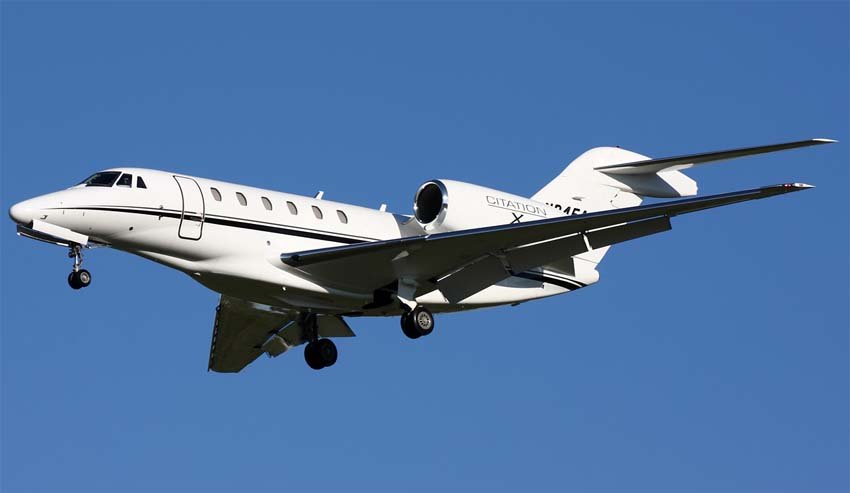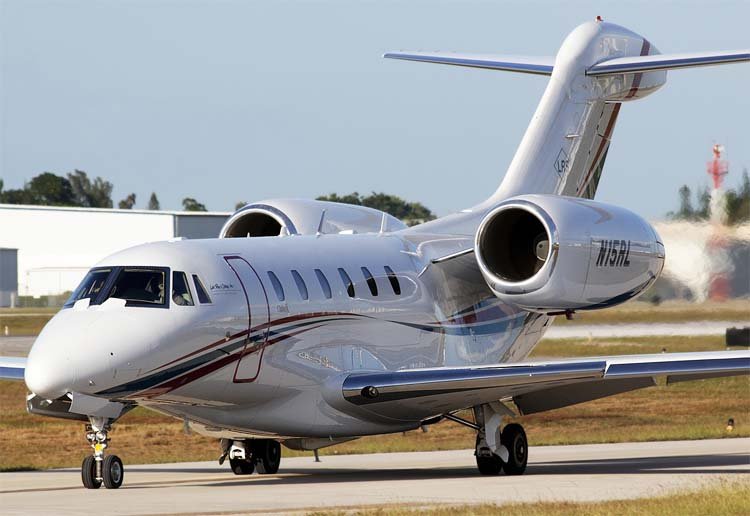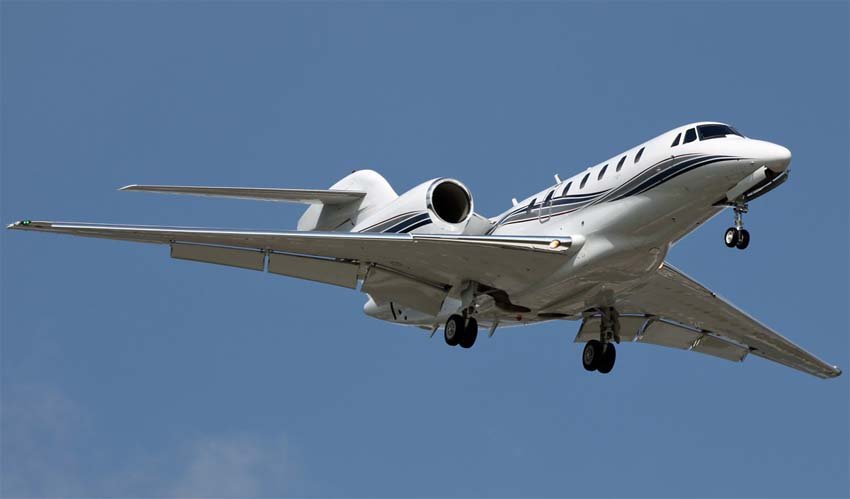
The Cessna Citation X is an executive aircraft (a light business jet) developed by the American firm Cessna Aircraft Company. Cessna announced the Citation X in October 1990 at the annual NBAA meeting. Engine testing was conducted on a Citation VII starting August 21, 1992. The prototype’s fuselage was joined to the wing in June 1993.
The first flight occurred on December 21, 1993, at 4:42 PM, with Doug Hazelwood and Ken Kimball at the controls. The total flight time was 45 minutes. Two subsequent experimental aircraft made their first flights on September 27, 1994, and January 11, 1995. Together, they spent over 3000 hours in the air before FAA certification was granted on June 3, 1996. Certification was initially anticipated in August 1995, but a change in payload weight led to a delay.
Origins and Development
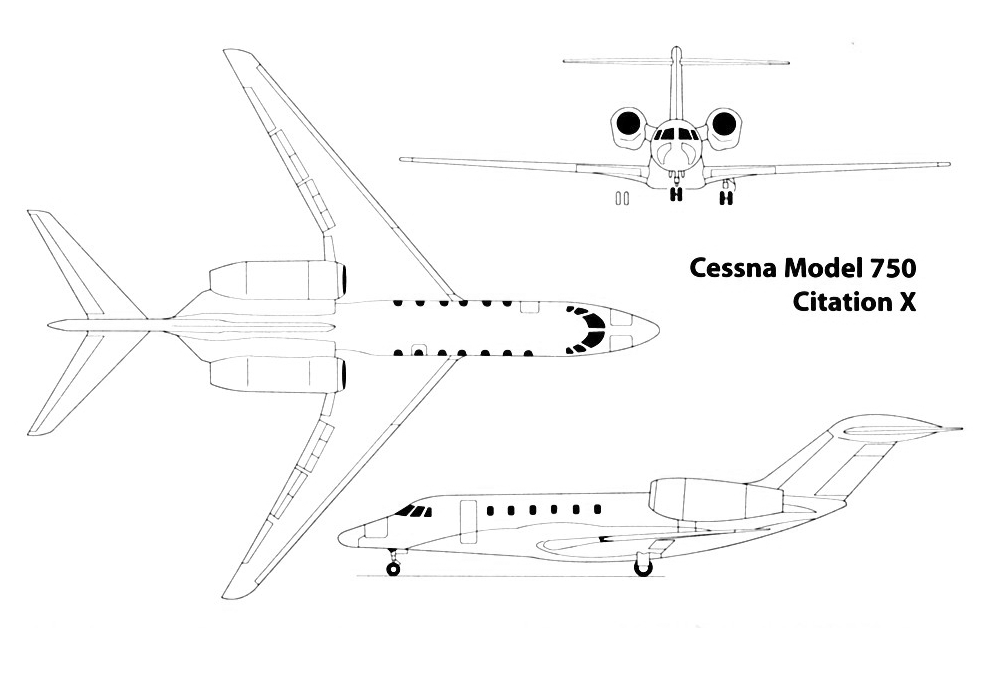
The Citation X follows the same design scheme as other mid-sized aircraft in the Citation family but features a wing with a 37° sweep along the quarter-chord line. The wing-fuselage joint is covered by a large fairing, which houses most of the 5900 kg of fuel onboard. The wing’s trailing edges are occupied by three-section flaps and ailerons, while almost the entire span of the leading edges is taken up by two-section slats.
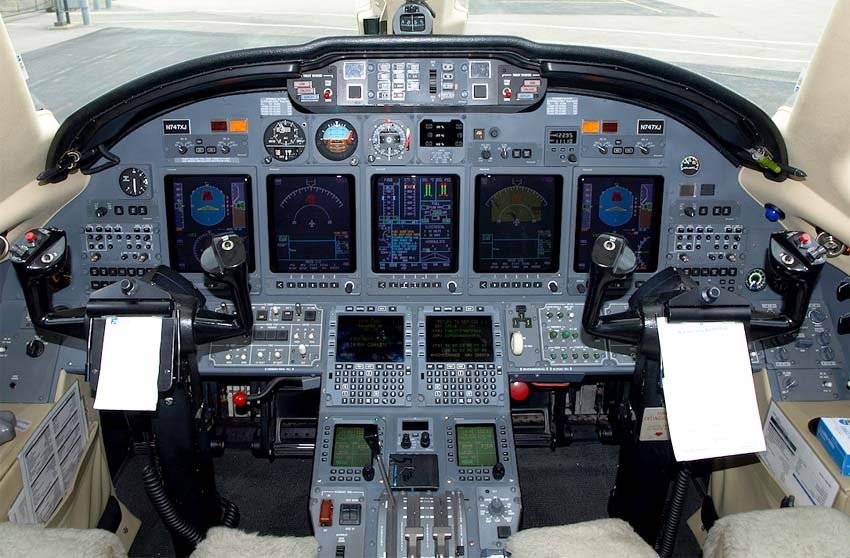
The tail assembly is T-shaped, and the fuselage has a circular cross-section with a reinforced “enhanced survivability” structure in the pressurized cabin area. Each landing gear strut is equipped with twin tires. The cockpit is designed for two people and features avionics based on the Honeywell Primus 2000. The flight information display systems consist of five screens: one primary flight data indicator and one multi-function indicator for each crew member, and one central EICAS (Engine Indication and Crew Alerting System) indicator.
Design Features and Aerodynamics
Thanks to Rolls-Royce engines and remarkable aerodynamics, the Cessna Citation X has become one of the most economical aircraft in business aviation history. It is the fastest business jet in the world and, simultaneously, the most aerodynamically advanced. As a result, its fuel consumption is comparable to much slower aircraft in its weight class, which are capable of carrying fewer passengers.
During the design of this aircraft, particular attention was paid to developing ideal aerodynamic qualities. Every contour and protrusion of the fuselage was engineered to minimize air resistance, thereby increasing the aircraft’s speed and efficiency.
The wings of the Cessna Citation X family of aircraft are swept back at a 37-degree angle, which is more than any other business jet. Nevertheless, it offers exceptional stability during takeoff and landing, and its unique wing shape significantly reduces air resistance, further cutting down fuel consumption.
Luxurious Interior and Notable Records
An intriguing paradox: one of the most beautiful and luxurious places on Earth is often located several kilometers above its surface. Even more paradoxically, having entered such an attractive place, people leave it so quickly. The Cessna Citation X quietly and swiftly transports its passengers to their destination in exceptionally short times.
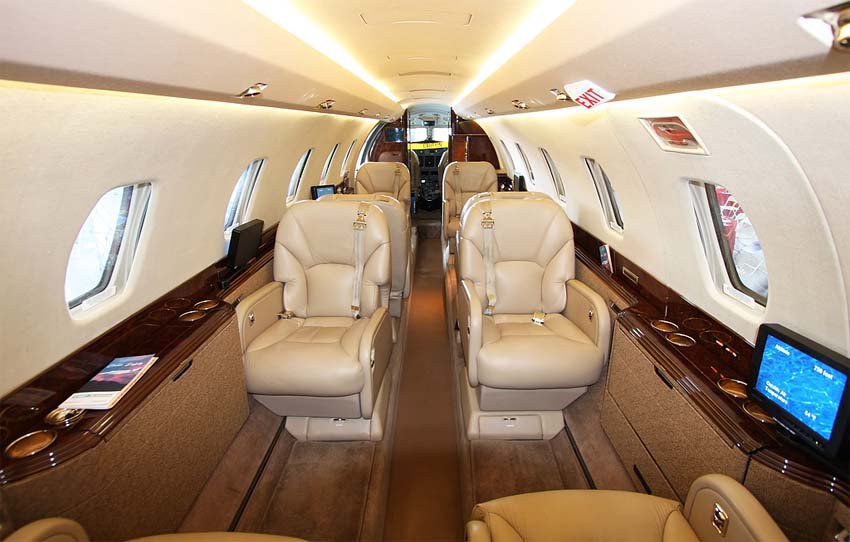
The aircraft’s cabin is a source of particular pride for the designers of this Cessna model: it is the widest, most spacious, and extraordinarily beautiful. It features soft and resilient seats, comfortable headrests and armrests, and enough room to recline the seat into a horizontal position for comfortable sleep.
The cabin length is over seven meters. There is a spacious and heated baggage compartment, measuring over two cubic meters, suitable even for bulky luggage. The cabin layout can have various configurations, with the most common option being an eight-seat cabin with a mini-bar, a spacious wardrobe for outerwear and hand luggage, a lavatory, and a baggage compartment in the aircraft’s tail.
However, this option is not mandatory: the interior design of the Cessna Citation X cabin can be fully customized, taking into account all customer wishes. One can choose the color and quality of leather, fabric, wood, and other finishing materials, as well as the layout of cabin partitions, the galley, the flight attendant’s station, the communication hub, and other necessary elements. The ample space inside the aircraft allows for the realization of any design fantasies.
Aircraft deliveries began in August 1996, with the first aircraft (number 003) handed over to golf legend Arnold Palmer. In February 1997, the Citation X development team was awarded by the National Aeronautic Association as the first commercial aircraft in US history to achieve a cruise speed of Mach 0.92. The 2500th Cessna Citation was a Citation X, delivered on September 10, 1997.
During the Reno Air Races in September 1997, the Citation X set a speed record over a 5000 km closed circuit, reaching 876 km/h. Furthermore, three years later, on July 14, 2000, this record was broken by an aircraft of the same type. J. Stephen Fossett and Darrin L. Adkins (USA) set a speed record for a 5000 km closed-circuit flight without cargo in class C-1h (turbojet aircraft with a takeoff mass of 12t to 16t). They departed from Alamosa airfield in a Cessna 750 Citation X (registration N377SF) with Rolls-Royce AE3007C engines, achieving a record of 921 km/h.
In the same year, using the same aircraft, these pilots set a speed record for a round-the-world flight in class C-1h (the flight, of course, included intermediate landings, and only flight time was considered for speed calculation). Completed on February 16, 2000, the flight along the route Los Angeles-Hamilton-Agadir-Luxor-Calcutta-Nagasaki-Midway Island-Los Angeles achieved an average speed of 901.07 km/h.
On November 24, 2000, J. Stephen Fossett, Alexander M. Tai, and Pierre F. d’Avenas set a speed record in class C-1h for a westbound flight in the same aircraft. The average speed on the route Cabo San Lucas, Kona, Majuro, Palau, Singapore, Male, Nairobi, Abidjan, Fortaleza, Barranquilla, Cabo San Lucas was 805.59 km/h.
In December 1997, Cessna expanded its five-year warranty. On May 22, 1998, the first Citation X was delivered to a Canadian customer.
The 50th Citation X was delivered in August 1998 to Executive Jet Aviation, and on December 23, 1999, Russ Meyer, Chairman and CEO of Cessna, handed over the keys of Citation X serial number 100 to Ted Townsend, President of Townsend Engineering. By October 1999, Citation X aircraft had accumulated over 80,000 flight hours.
Today, the Cessna Citation X is the fastest civilian aircraft in the world, easily approaching the sound barrier with a cruising speed just under one thousand kilometers per hour. To date, all Cessna Citation X family aircraft operating worldwide have performed approximately one million takeoffs and landings. If all the routes flown by these aircraft were combined, the result would be equivalent to four trips from Earth to the Sun. The average active lifespan of aircraft of this brand exceeds that of most other private jets.
The development team for the Citation X aircraft family continuously strives to improve its creation, monitoring all scientific, engineering, technological, and design innovations in aircraft manufacturing to apply the best achievements of human thought in each subsequent modification of the aircraft.
Technical Specifications
| Modification | Cessna 750 |
| Wingspan, m | 19,38 |
| Aircraft length, m | 22,05 |
| Aircraft height, m | 5,84 |
| Wing area, m2 | 48,96 |
| Empty weight | 9730 |
| Maximum takeoff weight | 16140 |
| Engine type | 2 Turbofan Rolls-Royce AE 3007C |
| Thrust, kN | 2 x 28,66 |
| Maximum speed, km/h | 1002,8 |
| Cruising speed, km/h | 991,9 |
| Practical range, km | 6350 |
| Practical ceiling, m | 15545 |
| Crew, crew members | 2 |
| Payload | up to 12 passengers |
Image gallery of the Cessna Citation X