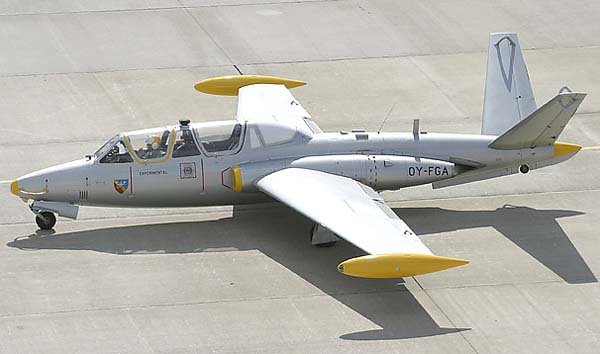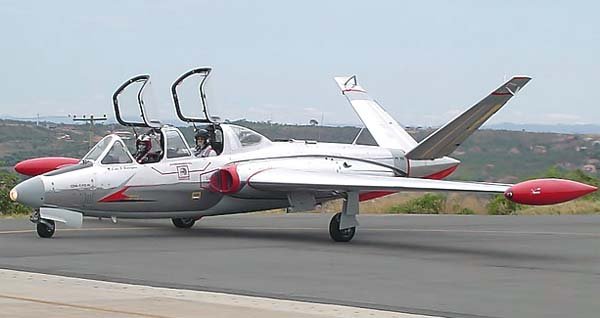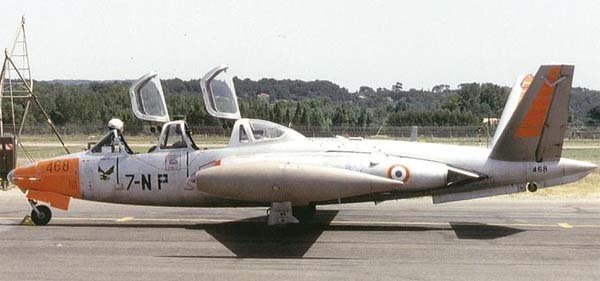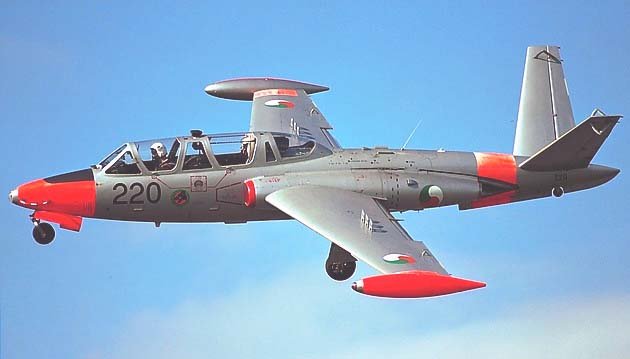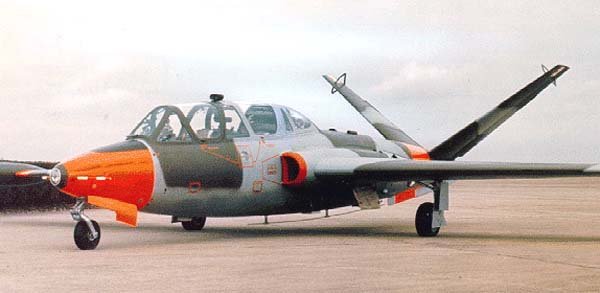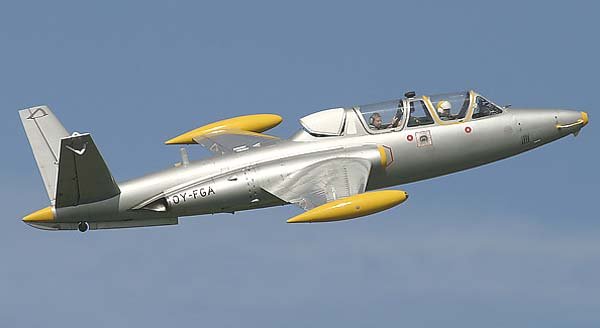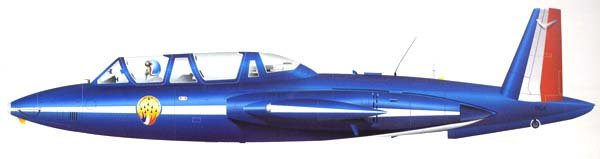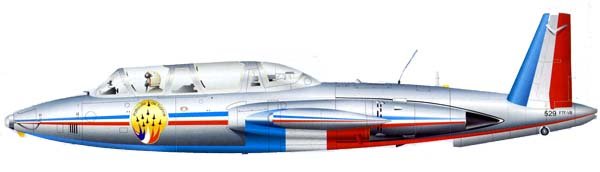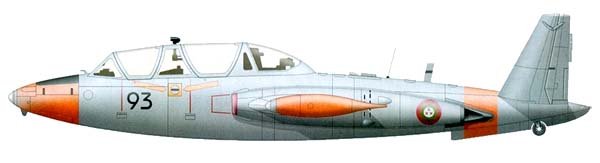
The CM.170 Magister was the first purpose-built mass-produced jet trainer, proving effective in local conflicts also as a light attack aircraft. In 1948, the Fouga company, previously specialized in light sports and training aircraft, began developing the world’s first jet aircraft for primary training, designated CM.130R. This aircraft was intended to replace the piston-engine Morane-Saulnier M.S.475 trainers in the French Air Force.
To gain experience with turbojet engines, Fouga built the CM.8R-13 Sylphe light sports aircraft in 1949. This was essentially a CM.8-13 glider equipped with a Turbomeca Piméné turbojet (1 x 10⁹ kgf). The design of the jet trainer was carried out under the leadership of engineers Robert Castello and Pierre Mauboussin. Initially, small Turbomeca Palas turbojets (3 x 160 kgf) were selected as the powerplant.
The project attracted the interest of the Directorate of Technical and Industrial Affairs, the main customer for aviation equipment in France in the late 1940s. However, the aircraft’s insufficient thrust-to-weight ratio did not satisfy the Air Force. Confident in the chosen direction’s prospects, Fouga proposed a heavier aircraft, the CM.170R, in 1950. It featured a layout similar to the CM.130R, including a tandem crew arrangement, a relatively straight wing with high aspect ratio, and engines on the fuselage sides.
Crucially, the CM.170R boasted a significantly more powerful propulsion system: two Marboré II turbojets, each with 400 kgf of thrust, developed under I. Szydlowski. In December 1950, the French Ministry of Aviation awarded Fouga a contract for the construction of three prototype aircraft.
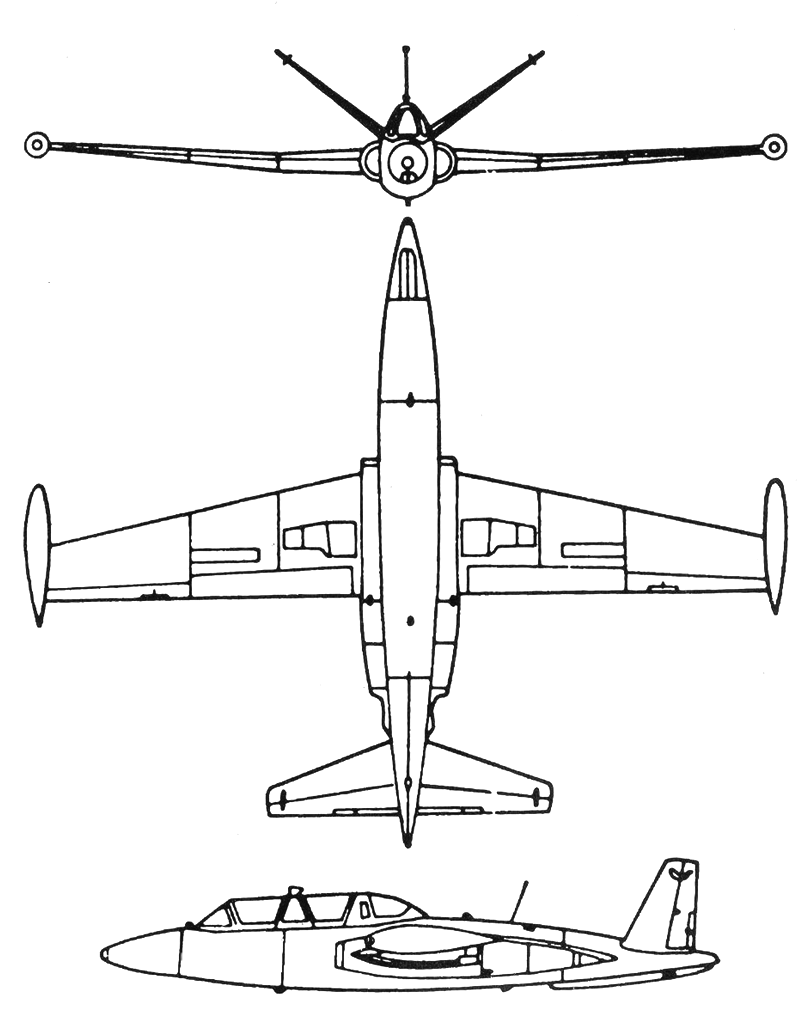
Distinctive features of the new aircraft included a high-aspect-ratio wing and a unique V-shaped tail with surfaces angled at 45° to the horizontal, similar to the CM.8R-13 motorglider. For comparative evaluation, one prototype was fitted with a conventional tail, which, however, showed no advantages and was heavier.
The first flight of the CM.170R Magister prototype took place on July 23, 1952, piloted by test pilot Leon Bourrie. Tragically, on November 3 of the same year, the aircraft was lost in an accident. Just 11 days after its first flight, on February 3, 1953, the third Magister prototype was also lost. Despite these setbacks, the French Air Force placed an order for 10 pre-production CM.170R aircraft in July 1953, followed by an order for 95 first-series CM.170 trainers in August of the same year.
Magister Production and Variants
Factory trials of the first production aircraft began on February 29, 1956, and by March, the trainer had already been delivered to the French Air Force flight test center. In total, the French Air Force received 394 CM.170 aircraft out of 576 of this type built by Fouga. A specialized naval trainer, the CM.170M (Marine), equipped with an arrestor hook, was developed for the French Navy, making its first flight on July 31, 1956.
After trials in France, these aircraft conducted several flights from the decks of the British aircraft carriers HMS Bulwark and HMS Eagle in 1957-1958. The French Navy acquired 30 such aircraft, designated CM.175 Zéphyr. The first production Zéphyr made its maiden flight on May 30, 1959.
Magister production was also established under French license in Finland, where Valmet supplied 59 aircraft to the Finnish Air Force. In West Germany, CM.170 aircraft were built by Flugzeug-Union Süd. The Luftwaffe received 194 CM.170 trainers, which differed from French machines by having Martin-Baker CZ4 ejection seats.
In Israel, between 1956 and 1960, the Bedek company assembled 30 CM.170s from French parts, transitioning to independent production from 1961. Unlike the French Magisters, Israeli aircraft had permanently installed weapon hardpoints, allowing immediate use in combat without additional retrofitting. Negotiations for selling a Magister production license to the USA were unsuccessful.
Israeli aircraft, after modernization by IAI (the new name for Bedek from 1967), were renamed “Tzukit.” To this day, they form the backbone of the Israeli Air Force’s training aircraft fleet.
In 1955, the experimental CM.171 Marakau trainer was produced, powered by two Turbomeca Gabizo engines (2 x 1100 kgf), making its first flight on November 5, 1956. This aircraft featured more spacious engine nacelles, with its wingspan increased to 13.21 m and area to 21.60 m². However, this machine was lost in a crash on March 20, 1957, with both crew members perishing.
On June 9, another experimental Magister modification, the CM.173 (Potez 94), also known as the “Super Magister,” made its first flight. This aircraft featured two Marboré VI turbojets (2 x 520 kgf) and ejection seats. Despite some improvements in flight characteristics, this trainer was not adopted by the French Air Force and remained a single prototype.
On March 19, 1962, tests began for the Franco-German Potez/Heinkel 191 administrative aircraft. This variant differed from the original trainer by featuring a wider fuselage, capable of accommodating four people (one pilot and three passengers). Intended for both military and civil transport, it was equipped with Marboré VI turbojets (2 x 480 kgf). Two prototypes were built.
Flight trials of the experimental Fouga 90 aircraft, a profound modernization of the CM.170, commenced on August 20, 1978. It featured a new fuselage with a “humped” canopy for improved visibility, along with new Turbomeca Astafan IIC engines (2 x 690 kgf). Later, the aircraft was re-equipped with more powerful Astafan IV turbojets (2 x 780 kgf) and new avionics were installed. However, no orders for the Fouga 90 followed.
Operational History and Users
The Austrian Air Force received 18 French-built Magister aircraft between 1959-1963, which were replaced by SAAB-105 trainers in 1971-1972. Twenty-eight Magister aircraft, formerly of the Luftwaffe, were supplied to Algeria in the late 1960s after a major overhaul by SOGERMA. Currently, 18 of these continue to serve as light attack aircraft and trainers.
In 1979, the Bangladesh Air Force acquired eight CM.170 aircraft previously operated by the French and Togolese Air Forces. In the mid-1980s, these were supplemented by another six Magisters from the German Air Force. (By now, they have been replaced by T-37B trainers). The Belgian Air Force acquired 45 French-built CM.170 aircraft in 1960-1962, replacing their North American Harvards.
In the late 1960s, four German-built Magisters were added. Belgium also brokered the delivery of nine Magister aircraft to the rebellious Katanga province of Congo. After the end of the Congolese Civil War, some of these aircraft were transferred to Cameroon, Ireland, and Rwanda. Most Belgian Magisters have since been replaced by Alpha Jet trainers, but 18 aircraft are still in operation.
The Brazilian Air Force operated seven French-built Magister aircraft between 1968-1975, which were used by the “Esquadrilha da Fumaça” aerobatic team. In the early 1980s, the Gabonese Air Force acquired seven used Magister aircraft from Austria, employing them as attack aircraft. The Guatemalan Air Force had three French-built Magister aircraft, acquired from West Germany, until the 1980s.
The German Air Force (Luftwaffe) received 40 French-built CM.170s and 194 license-built aircraft from West Germany, replacing their North American T-6G trainers. The first Magister was delivered to the Luftwaffe in July 1957. The Irish Air Corps operates six Magister aircraft. Two were purchased from Belgium (which had previously sold them to Katanga and stored them), and four trainers were acquired from Austria. Additionally, a non-flyable airframe, purchased from France, is housed at a training center.
In 1956, Israel ordered 34 Magisters: four were built by Fouga in France, and 30 were assembled by the Israeli firm IAI-Bedek from French parts. Their entry into service began in 1960, followed by a second order for 16 aircraft delivered between 1961-1963. In total, 80-100 Magister aircraft were built or assembled in Israel.
Cambodia acquired four CM.170 aircraft in 1958. Cameroon purchased four Magister aircraft in 1973 that had previously served with the Katangan Air Force and were stored in Belgium. In 1979-80, two more French trainers were acquired. Three of these are used as light attack aircraft and three as trainers (some are currently in storage).
Lebanon ordered four new CM.170 aircraft from France in 1962. Additionally, eight aircraft of this type were acquired from the West German Air Force and six from the French Air Force. Flights of the last Lebanese Magisters ceased in 1991. Libya operated 12 CM.170 aircraft (eight French-built and four German-built) in its Air Force until the mid-1980s. Morocco purchased its first batch of CM.170 aircraft from France in 1962. In 1968-1969, an additional 28 aircraft, overhauled and modernized, were acquired from West Germany. Currently, 18 Magister aircraft remain in service with the Moroccan Air Force.
Rwanda acquired three Magisters from Belgium in 1975. El Salvador purchased six CM.170 aircraft from Israel in 1975. After receiving Cessna A-37B attack aircraft from the USA in 1984, the Magisters were mothballed, though three attack variants were reactivated in 1993. In February 1976, Senegal acquired five CM.170 aircraft from Brazil, which had undergone major overhaul and modernization by SOCERMA. They are primarily used as light attack aircraft.
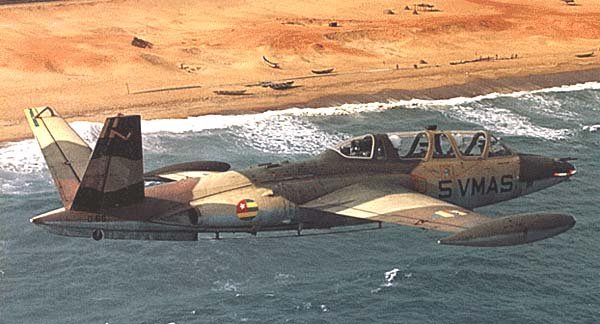
In 1976, the government of Togo purchased one CM.170 from the French Air Force and four more from the West German Air Force. Two more ex-French aircraft were later added. They remained in service until the mid-1980s and were proudly classified in Togo as “fighters.” Deliveries of Magister aircraft to the Finnish Air Force began in December 1959. Initially, the Finns received 18 French-built aircraft.
This was followed by five Magisters assembled by the Finnish firm Valmet from French parts. Subsequently, the Air Force received 59 purely Finnish-built aircraft. The last Magister trainer was withdrawn from Finnish Air Force service in July 1988.
Nine CM.170 aircraft were acquired by the government of Katanga, a breakaway province of Congo, with the help of Belgian intermediaries. Three of these were relocated to Kolwezi airfield on February 15, 1961, and immediately engaged in combat operations during the civil war unfolding in the country. Ground and flight personnel were Belgian mercenaries.
One of the aircraft was soon shot down, and a second was confiscated by UN forces in August 1961. The third attack aircraft was used in the civil war until January 1963 and was destroyed during the final phase of the conflict. The remaining six Magisters did not reach the theater of operations. Israeli CM.170 aircraft, though nominally assigned to flight schools, consistently carried weapon hardpoints and could, if necessary, participate in combat operations without additional modifications. They were successfully employed against Egyptian and Syrian forces in 1967 and 1973. Moroccan Air Force CM.170s were also used in combat operations in the Sahara against the Polisario Front, serving as attack and reconnaissance aircraft.
Aircraft Design and Systems
The aircraft is built according to a conventional aerodynamic design, featuring a mid-mounted, high-aspect-ratio wing, a V-shaped tail, and a tandem crew arrangement. The three-spar, stringer-less wing, with a leading edge sweep of 13°, employs a NACA 64 profile. Its relative thickness is 19% at the root and 12% at the tips. Ailerons, with internal aerodynamic and mass compensation, are equipped with electrically controlled trim tabs. Fowler flaps, when deflected to 40°, also serve as airbrakes. The fuselage is of semi-monocoque type, and the crew cabin is pressurized.
For its powerplant, the Magister is equipped with two Turbomeca Marboré IIA (2 x 400 kgf) or Marboré VIC (2 x 480 kgf) turbojets, mounted on the fuselage sides. Air intakes are semicircular and located laterally. Fuel is stored in two fuselage tanks with a total capacity of 730 liters. Additionally, two 120-liter tanks can be installed at the wingtips. A special tank ensures engine fuel supply during inverted flight for 30 seconds.
The aircraft’s general systems include a 24V DC electrical network, powered by a 2.4 kW generator driven by the left engine, supplemented by a battery. A dual-channel hydraulic system, operating at 250 kgf/cm², actuates the flaps, airbrakes, and wheel brakes. A manual pump is available for emergency landing gear and flap extension.
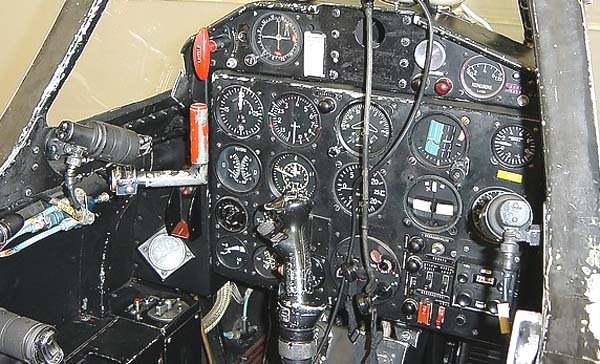
Targeting equipment includes two high-frequency radio stations (a primary 12-channel and a two-channel emergency unit) and a radio compass. An optical sight in the front cockpit is used for aiming during firing and bombing runs.
For armament, two built-in machine guns of 7.5 or 7.62 mm caliber, with 200 rounds per barrel, can be installed in the fuselage. Under the wings, four unguided rockets (120 mm), two rocket pods (7 x 68 mm or 18 x 37 mm), two 50 kg free-fall bombs, or two Nord SS.11 anti-tank guided missiles can be suspended.
Technical Specifications
| Armament: | two 7.62-mm or 7.50-mm machine guns with 200 rounds per machine gun, combat load – 140 kg on 2 hardpoints, launchers for 18×37-mm or 6×68-mm or 9×81-mm unguided rockets, or 2 50-kg bombs, or 2 air-to-surface missiles AS.11 |
Image gallery of the CM.170 Magister