The contribution of the American arms company “Colt” (to be precise, Colt’s Manufacturing Company) to the combat potential of the Russian army can undoubtedly be considered one of the “blind spots” in the history of the Great War. Although in public consciousness, thanks to popular literature and cinema, the word “Colt” is firmly associated with cowboys and revolvers, in the Russian trenches it was well-known due to a much more formidable weapon: the Colt M1895/1914 heavy machine gun.
The War Department of the Russian Empire purchased these in very large volumes for the needs of the active army. On the Russian front, this system was second only to the legendary “Maxim,” which was produced in domestic factories, in terms of the number of barrels. Deliveries of “Colts” from the USA allowed, if not to overcome, then at least to significantly reduce the acute deficit of automatic weapons in Russian infantry units.
However, in Soviet Russia, these machine guns did not last long, as they were withdrawn almost immediately after the end of the Civil War. This was largely due to the barrel’s operational fragility, a small stock of spare parts, and, crucially, the reorientation of Soviet arms production towards developing its own automatic weapon systems.
The Genius of John Browning
The creator of the Colt M1895/1914 machine gun was the famous American, and later Belgian, armorer John Moses Browning. Remarkably, this outstanding designer of small arms and automatic weapons, who received 128 patents in his lifetime, was born into an American Mormon family.
Jonathan Browning, John Moses’s father, was a devout Mormon who moved to Utah in the late 1840s. He had 22 children from three wives and was a keen enthusiast and expert on firearms. In 1852, with the support of the Mormon community, Jonathan Browning opened his own gunsmithing workshop. John Moses Browning later recalled that by constantly playing with weapons being repaired, he learned the names of parts, details, and mechanisms of various weapon systems even before he learned to read.
Gun history literature suggests that John Browning designed his first single-shot rifle, as a gift for his brother Matt, at the age of 14. It is possible this refers to the modernization of an existing system rather than original design. However, it is a well-established fact that Browning received his first firearms patent at 23.
The single-shot rifle from this patent was named “J. M. Browning Single Shot Rifle” and was produced as “Model 1879.” Browning later modified his original system, and the “Model 1885” rifle is still produced in the USA today.
As S.L. Fedoseev points out in his arms treatise (the only specialized Russian-language study on the “Colt” machine gun to date), in the early 1870s, Browning began work on “automating” a repeating rifle. His first “protomachine gun” was based on the Winchester M1843 lever-action rifle, which is well-known to fans of American Westerns. Browning introduced a special mechanism into the rifle’s design that diverted some of the propellant gas energy upon firing to reload the weapon.
Given that the arms firm of brothers John and Matt Browning, “J.M. Browning & Bros,” was financially and technologically modest, the gas-operated reloading idea was proposed to the large arms firm “Colt” for joint development. S.L. Fedoseev cites an interesting entry from the diary of K. J. Ebets, head of advanced development at Colt: “Today, June 10, 1891, two of the ten Browning brothers were here to discuss their machine gun, a model of which John brought as early as May 1. We agreed to try to implement the principle of using gas to power the weapon’s mechanism as soon as possible, to preempt Maxim’s claims of priority.”
This note refers to armorer Hiram Maxim, creator of the famous and most widely produced machine gun in military history, the “Maxim-Vickers.” As we can see, competition in the American market for automatic weapon inventions and production in the late 19th century was exceptionally fierce. Different arms firms were literally “neck and neck” in their developments, with patenting advantages often not exceeding a few weeks, and sometimes even days.
The patent application for the machine gun, refined at the Colt firm, was submitted to the U.S. Patent Office on August 3, 1891. Over the next few years, the machine gun’s design was protected by three more patents. Simultaneously, work continued on improving this automatic system and establishing the technological cycle for its industrial production.
The alliance of John Browning’s engineering genius and Colt’s financial capabilities eventually bore fruit. In 1896, the U.S. Navy adopted the Colt M1895 machine gun chambered for the 6mm Lee cartridge. Around the same time, the U.S. Army acquired a small series of Colt M1895 machine guns in a version chambered for the .30-40 Krag cartridge.
Design and Peculiar Operation
Browning’s machine gun was first used in combat during the Spanish-American conflict of 1898 in Cuba. However, the Colt M1895 found truly mass application only during the Great War of 1914-1918, and, surprisingly, primarily in the Russian army. On the Russian front, unlike in the American army, this machine gun became a truly mass weapon, second only to Hiram Maxim’s machine gun in total number of barrels. The machine gun for the Russian defense order underwent modernization (reinforced barrel, modified mount) and was released under the designation Colt Model 1914.
Besides Russia, Browning’s creation was purchased in relatively small series for the armed forces of Great Britain, Belgium, and Italy. In the Italian army, the Colt M1895 was used for the longest period: until the end of 1943, these machine guns armed “second-line” defense units, formed from Mussolini’s “Blackshirts” volunteer organizations.
John Browning, when creating his first machine gun, apparently tried to simplify the system as much as possible, making it so field-repairable that it could be fixed in front-line conditions with the simplest tools—a hammer, a file, and a wrench. This technical approach of the designer is evident in the machine gun’s gas engine mechanism, responsible for reloading the system, which was very simple and maximally accessible for external repair.
The vast majority of gas-operated reloading systems feature a linearly moving piston, which moves under the pressure of propellant gases in a special tubular gas chamber located either below or above the weapon’s barrel. In modern weapon systems, this principle of gas port arrangement is widely applied: below the barrel in many Browning designs (e.g., the Browning Bar carbine), and above the barrel in domestic Kalashnikov assault rifles and Simonov self-loading carbines (SKS), as well as in the numerous family of German Heckler & Koch rifles and machine guns.
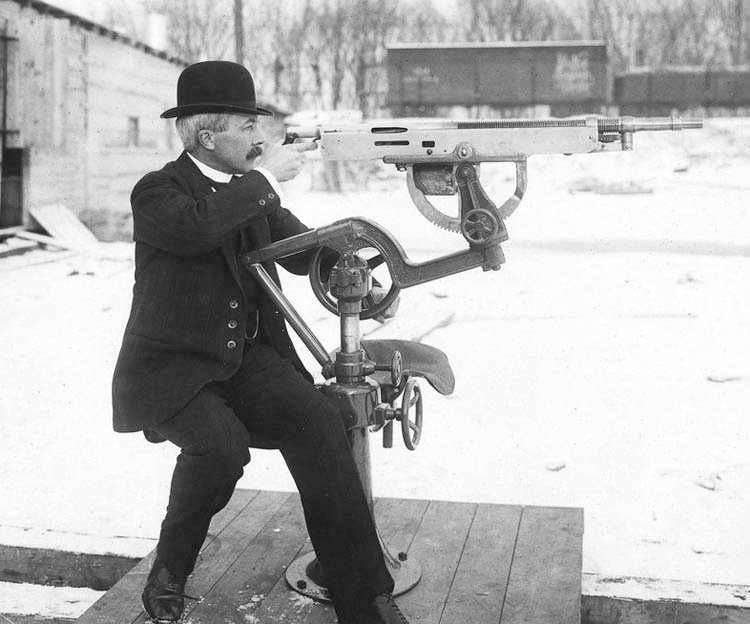
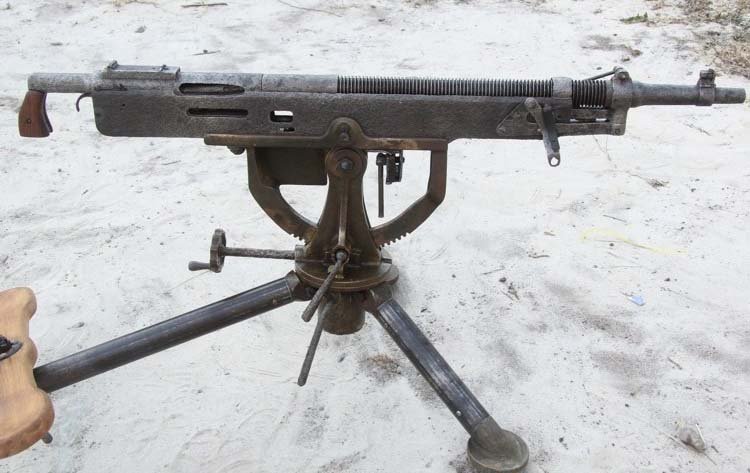
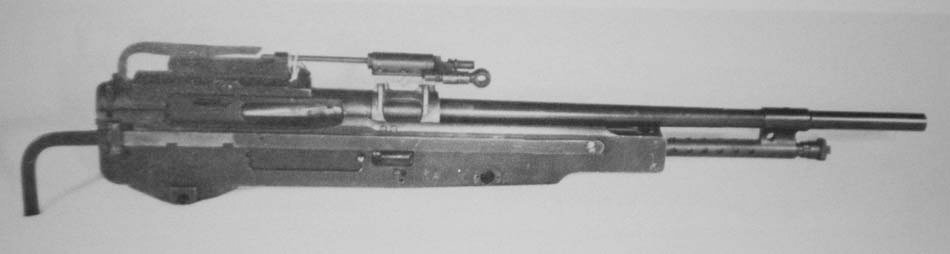
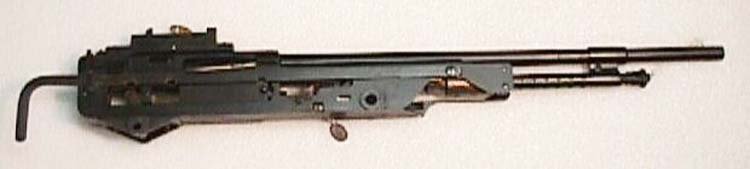
The automatic reloading system of the Colt M1895 machine gun is fundamentally different. Propellant gases upon firing, after passing through a special gas port in the barrel, did not enter a closed chamber but escaped into the atmosphere, having first struck the “heel” (a short piston) of a swinging lever-connecting rod. This lever, fixed at one end to a sleeve below the machine gun’s barrel, performed a semicircular—170˚ backward—movement in the lower under-barrel area, ejecting the spent casing, reloading the next cartridge, and cocking the mainspring.
The lever-connecting rod returned to its initial position under the action of two return springs, mounted in guide tubes under the barrel. At the same time, the bolt chambered the next cartridge, and if the trigger remained pressed, the next shot occurred. Since the main parts of the bolt group and reloading mechanism consisted of levers and springs, and almost all were exposed, making partial disassembly of the Colt M1895 machine gun and replacement of individual system elements straightforward.
The downside of this design was increased barrel vibration due to the long-stroke movements of the levers attached to the barrel. Vibration became an inherent flaw of the Colt M1895 machine gun and could not be eliminated even by a substantial increase in barrel weight or by a massive tripod mount until 1917.
The barrel shake of the Colt negatively affected the accuracy of fire from this machine gun, especially at long distances. Even experienced machine gunners firing the Colt could not achieve the accuracy easily demonstrated with the Maxim, Lewis, or even Madsen.
The Colt M1895 also had another, very unpleasant feature in front-line conditions: an excessively high profile. The machine gun, set up in the field on unprepared ground, instantly turned the soldier into effectively a half-body target. This characteristic of the “Colt” was determined by the need for at least 15-20 centimeters of free space beneath the machine gun for the pendulum-like movement of the lever-connecting rod. The lever’s movement below the machine gun precluded using the “Colt” without its standard, rather tall tripod mount.
In field conditions, the specific clanking sound from the movement of the reloading levers, as well as plumes of dust raised by the powerful discharge of propellant gases into the weapon’s lower hemisphere, gave the Colt M1895, in the opinion of soldiers, an external resemblance to a mechanical potato digger. “Potato digger”—this is what English-speaking soldiers called John Browning’s creation. This name could, of course, only arise among soldiers from the USA and Great Britain, where mechanical harvesting equipment was widely used.
In the Russian Empire during the Great War, the overwhelming majority of peasant conscripts had no idea what a “potato digger” was. Therefore, in the Russian army, the Colt machine gun was sometimes colloquially called the “Bull”—presumably for its resemblance to an enraged bull energetically throwing dust and dirt on itself with its front hooves.
The machine gun was fed from a canvas belt of 100 and 250 (later versions) rounds. The Colt-Browning 1895/14 was supplied with ammunition boxes and a “low tripod” machine gun mount, specially designed for the contract with the Russian military department. The mount was quite heavy—almost 24 kilograms. Together with the armored protective shield covering the shooter, the weight of the mount exceeded 36 kilograms. Meanwhile, the weight of the machine gun body itself was relatively small—16.1 kilograms.
The transportability of the “Colt,” even compared to the heavy Maxim machine gun, was unsatisfactory. The efforts of a two-person machine gun crew, if acutely necessary, were sufficient for moving and combat use of the “Maxim” on the battlefield. The “Colt” absolutely required a minimum of three machine gunners; otherwise, a machine gun moved to a new position risked being left without its “tripod,” or without its armored shield, or without ammunition.
The Colt in the Great War and Beyond
The machine gun complement of Russian army infantry units at the beginning of the Great War, to put it mildly, left much to be desired. A specialized study by S.L. Fedoseev reports that by the end of 1914, the Russian army was supposed to have 4,990 machine guns (for comparison, Germany had over 12,000 machine guns for the same period), but in reality, only 4,157 barrels had been supplied to the troops by August 1, 1914.
In June 1915, the Main Artillery Directorate of the General Staff (GAU) determined a monthly front-line need for 800 machine guns, and in October of the same year, the total army requirement for machine guns by January 1917 was planned to be 31,170 units. These calculations, as sources indicate, turned out to be knowingly underestimated, as by early 1917, about 76,000 machine guns had been supplied to the front due to extreme necessity. It is clear that the weak industrial base of the Russian Empire could not provide such a quantity of machine guns for the front.
With the assistance of the British government, in January 1915, the Russian GAU placed an order in the USA for an initial batch of one thousand “Colts.” The price of $650 per piece, as modern experts assert, was clearly inflated. However, subsequently, despite significantly larger orders, the Americans consistently refused to revise the price downwards. Having lost precious pre-war time, thinking more about building ambitious dreadnought battleships than about providing machine gun and artillery support for ground forces, the Russian military department was now forced to pay foreign manufacturers generously with gold rubles.
In August 1915, after testing the “Colt Model 1914” machine gun at the Officer Rifle School’s Firing Range, Major General Filatov, the head of the school, wrote: “It is very difficult for one person to load the machine gun… The variety of breakages, as well as their relatively large number, indicate the low strength of its parts.” As was often the case, the Russian order required sample improvements. For example, the first 1,750 machine guns were delivered with a high, so-called “French” tripod (such a tripod was supplied by Colt to France), and their slide mechanism was reinforced. General Sapozhnikov made significant efforts to ensure that “Colt” and “Marlin” began supplying “low” tripods. It was found that shields, measuring 685×445 millimeters, were more reliably produced at the Izhorsky Plant in Russia, using 6.5-millimeter armor steel.
At the end of 1915, the British ceded their order in the USA for 22,000 Maxim and Colt machine guns to the Main Artillery Directorate of the General Staff. In early 1916, placing orders for the manufacture of the Colt M1895 machine gun in the USA continued. On January 29, 1916, through English mediation, a contract was signed with the American firm “Marlin-Rockwell Corporation” for the supply of 12,000 “Colt” machine guns chambered for the Russian 7.62x54R flanged cartridge. Weapons from this order were to arrive in Russia no later than September 1916.
Almost simultaneously with Marlin-Rockwell, the Colt firm agreed to produce 10,000 “potato diggers” for the Russian military department. Subsequently, on September 28, 1916, another, this time final, contract was concluded with the Marlin firm for 3,000 Marlin M1895/15 machine guns—an almost complete analogue of the Colt.
The overwhelming majority of “Colt” machine guns supplied to Russia were significantly modernized. The barrel thickness was substantially increased, which improved ballistic performance and extended firing time before dangerous overheating. Due to the efforts of the Russian emissary in the USA, Major General A.N. Sapozhnikov, the height of the tripod mount was reduced, which somewhat lowered the machine gun’s vertical profile.
Russian-ordered “Colts” had a ladder sight with a diopter aperture in the form of a disk with five holes and a scale up to 2,300 meters. Combat use of the “Colt” sight was straightforward: the sight disk was rotated to the necessary aperture (depending on range and lighting) to the line of sight. The sight also featured a rational mechanism for introducing windage adjustments (corrections for derivation—bullet deflection in rifled weapons towards the direction of rotation—were automatically introduced when setting the firing distance).
According to military experts, the Colt-Browning 1895/14 was more maneuverable when firing from a prepared position than the “Maxim” machine gun. John Browning’s creation was likely the simplest automatic system, from a technical standpoint, used in the battles of the Great War.
The “Colt” machine gun consisted of only 137 parts, including just 10 screws and 17 springs. The almost ideally simple Austrian “Schwarzlose” machine gun had 166 parts. The British “Vickers” (a deeply modernized version of the “Maxim”) was assembled from 198 parts, 16 screws, and 14 springs. The Russian “Maxim” Model 1910 (whose design was later simplified and the number of parts reduced) had about 360 parts, 13 screws, and 18 springs.
However, in terms of operational longevity, the “Colt” machine gun could not even remotely compare to the “Maxim,” which had liquid barrel cooling. Early versions of the “Colt” could only fire in short bursts for very brief periods, as otherwise the barrel would glow almost red-hot and become unusable. The “Russian version” of the Colt-Browning 1895/14, which received a thick barrel and transverse finning, could fire longer bursts, but also for a relatively short duration. With the “Maxim,” however, advancing enemy formations could literally be “flooded” with lead.
The factor of insufficient operational durability of the “Colt’s” barrel and its relatively low rate of fire were, apparently, the reason why American machine guns were not particularly liked by soldiers in the Russian army. “When there’s no fish, even a crab is fish!”—goes the Russian proverb: the “Colt” machine gun was used only until it was possible to exchange it for a “Maxim” or a “Lewis.”
In total, 17,785 “Colt” machine guns were delivered to Russia during the war years, making this automatic system the second most common on the Russian front after the legendary “Maxim.” Despite the significant volume of deliveries from the USA, there was still a shortage of “Colt” machine guns (as well as machine guns of other systems) in front-line infantry units even at the end of the war. As of March 1, 1917, there were 2,433 “Colt” machine guns on the four Russian fronts, whereas according to the table of organization, there should have been at least 6,732 barrels in the troops.
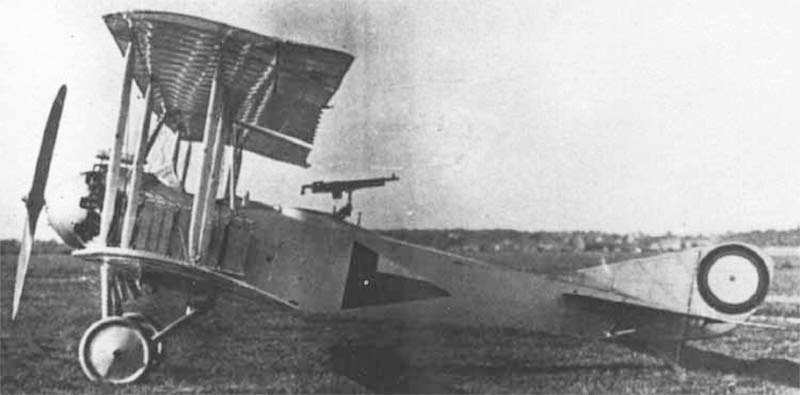
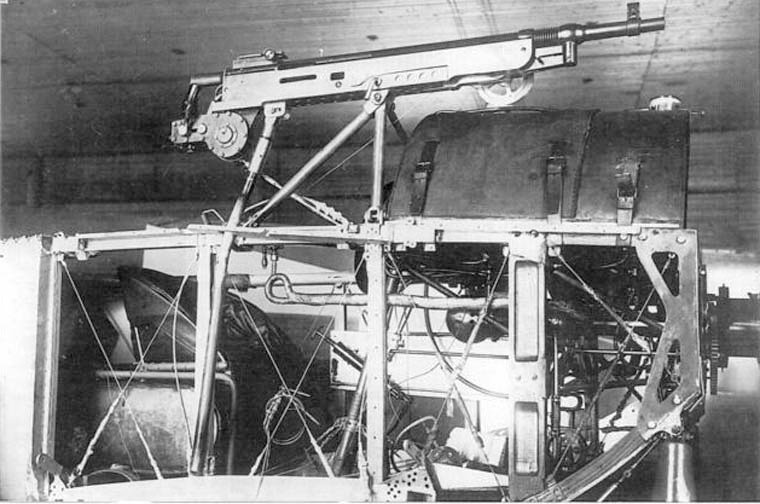
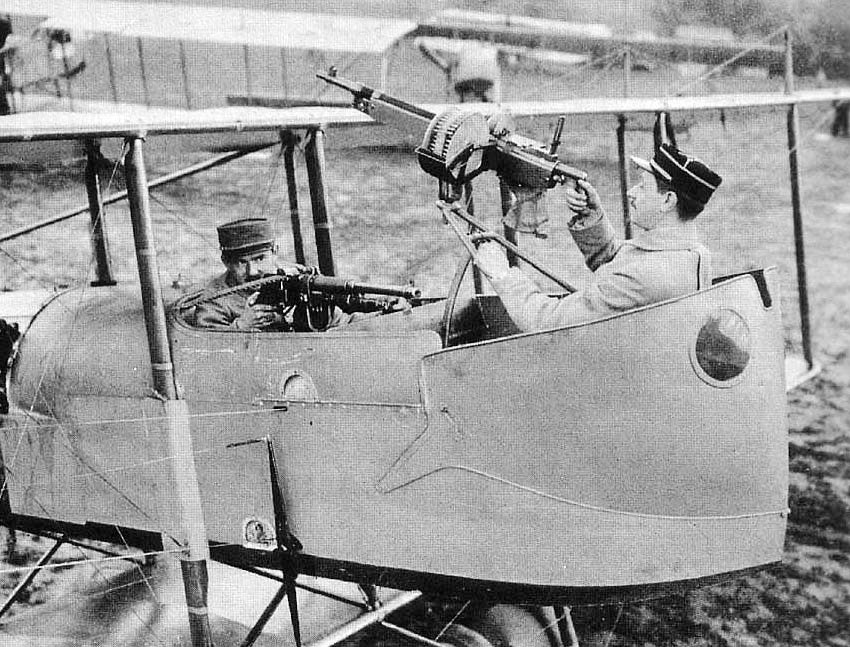
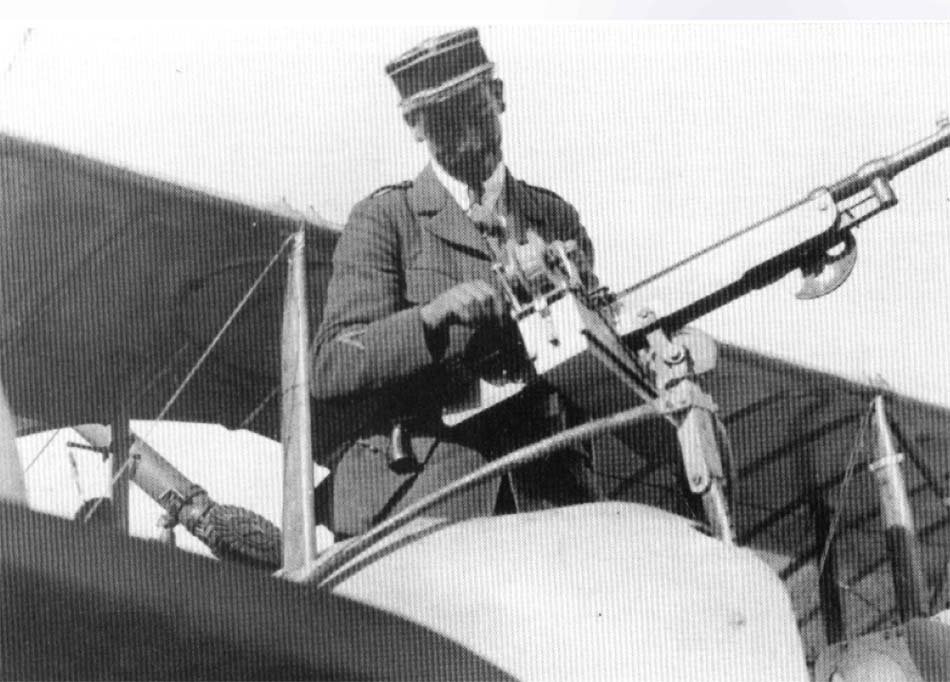
The “Colt” machine gun also found its place in Russian aviation. On October 4, 1915, General Sapozhnikov specifically purchased 67 “Colt” machine guns (7mm caliber) and a million rounds in England for aviation through a cash purchase. On April 30, 1916, they were transferred to the Aeronautical Department of the GVTT. However, shortly thereafter, the GVTT returned some of the machine guns to the GAU for adaptation for firing incendiary bullets.
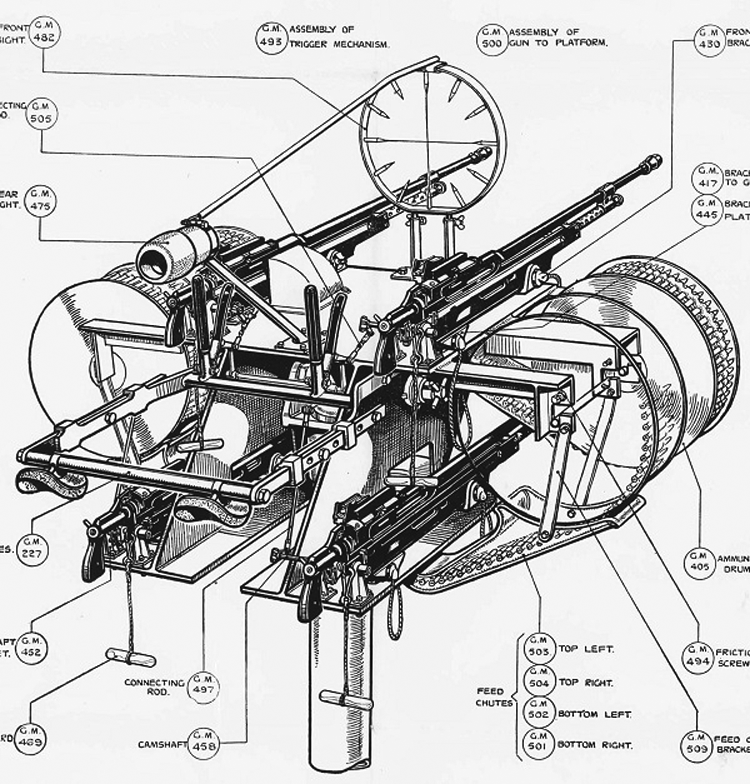
At the end of 1915, a tripod with a seat, a replaceable brass drum with a belt, and a wooden stock-grip were proposed for the “Colt” machine gun. This setup did not find application in the infantry, but the stock and drum were valued in aviation—drums with mounts, as well as bags for spent casings, were ordered from the “V.A. Lebedev” factory. The “Russian-Baltic Wagon Works” produced synchronized mounts for “Vickers and Colt system machine guns.”
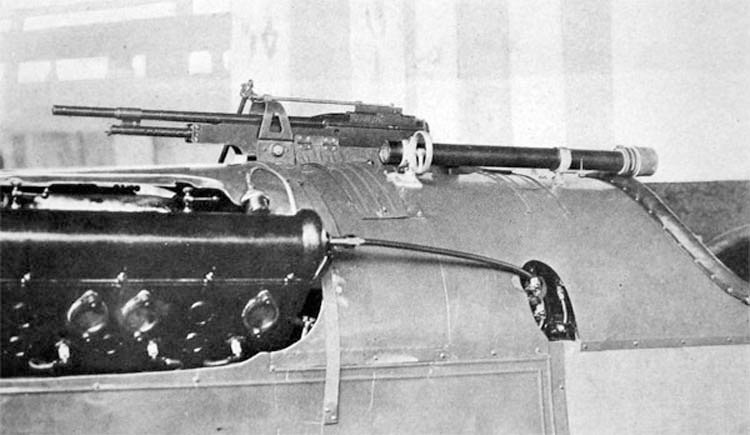
Somewhat later than the Russian Empire, the Colt machine guns were used as aircraft armament in the USA. The “Marlin-Rockwell Corporation,” which was fulfilling the Russian order for Colt machine guns, developed its own version of John Browning’s creation.
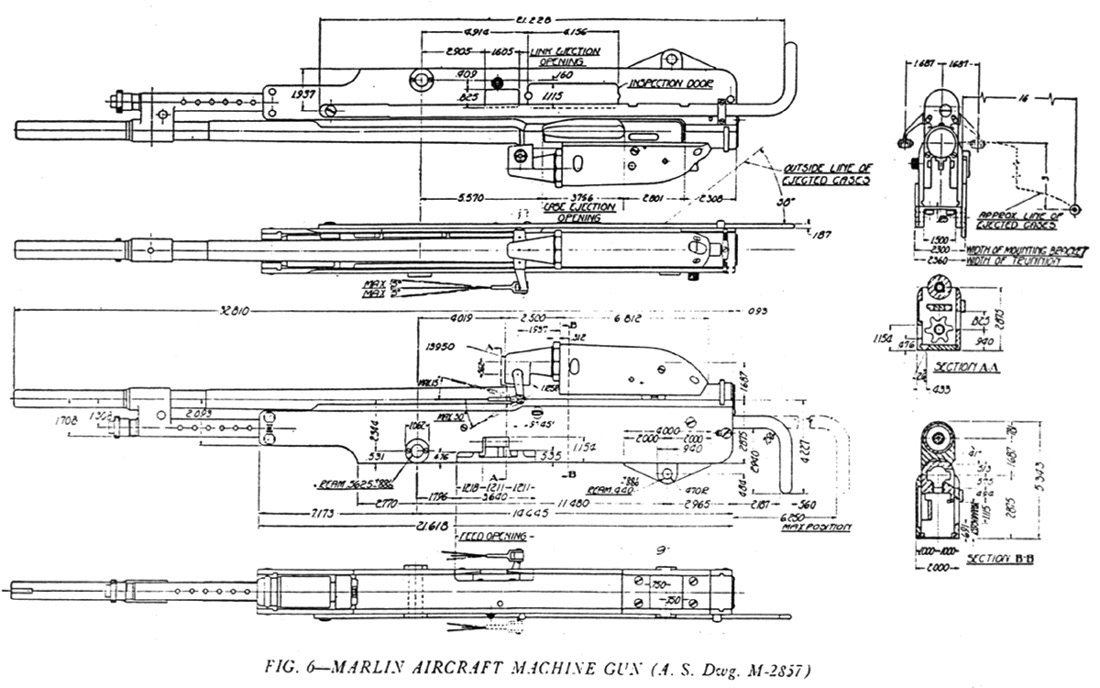
By 1917, Swedish armaments engineer Karl Swebilius, working for the Marlin firm, developed a version of the machine gun for tanks and armored vehicles. In this version, designated Marlin M1917, Swebilius eliminated one of the main drawbacks of the Colt-Browning 1895/14—the pendulum-like lever-connecting rod, which in Swebilius’s version was replaced by today’s traditional linearly reciprocating gas piston mechanism for gas-operated weapon systems. This solution was driven by purely utilitarian reasons—there was simply no space for John Browning’s lever design in the cramped confines of armored vehicles of that era. Furthermore, Swebilius managed to partially eliminate another drawback of the machine gun—the low durability of the barrel by introducing aluminum finning. A byproduct was an increase in the practical rate of fire of the Marlin M1917 machine gun to 650 rounds/min compared to 400 for the basic Colt model.
The increased rate of fire made possible Marlin’s proposal of a purely aviation version, the Marlin M1918, equipped with a mechanical synchronizer, also developed by Karl Swebilius. The Marlin M1918 aircraft machine gun came just in time for the concluding battles of World War I. In its final version, the Marlin machine gun weighed practically the same as the popular Lewis guns, but unlike them, it synchronized perfectly for use as offensive armament on fighters, and was also quite convenient as defensive armament. Furthermore, belt feed in aviation armament was significantly more convenient than the Lewis’s magazine feed.
Twenty-two squadrons of the U.S. Expeditionary Force, fighting in Europe in 1918, were armed with Marlin machine guns. This weapon was standard on American DH-4s, SPADs, Salmsons, and Breguets. According to American pilots, Marlin machine guns possessed exceptional reliability, functioning even at extremely low temperatures at high altitudes up to 4,500 meters. During tests, the Marlin M1918 withstood 10,000 rounds without a single malfunction.
By the end of hostilities in Europe, 15,000 Marlin M1918 and 23,000 Marlin M1917 machine guns had been supplied to the American army. With the end of the war, Marlin and Colt 1895 machine guns were superseded by more advanced Browning designs featuring short-recoil automatic actions. Nonetheless, they continued to be used in the army until 1925, when they were finally withdrawn from service. Although during World War II, “old timers” retrieved from warehouses were still used for auxiliary purposes, in police, coast guard, and also supplied to Great Britain for arming the Home Guard.
Image and diagram gallery of the Colt M1895 Machine Gun