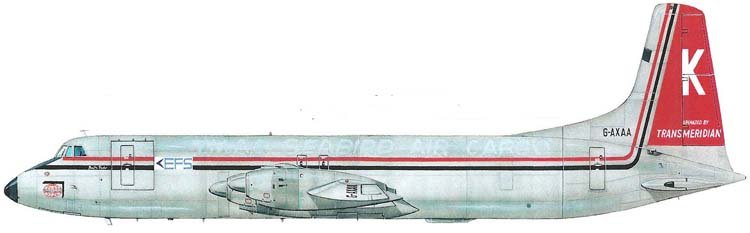
Origins and Development of the CL-44
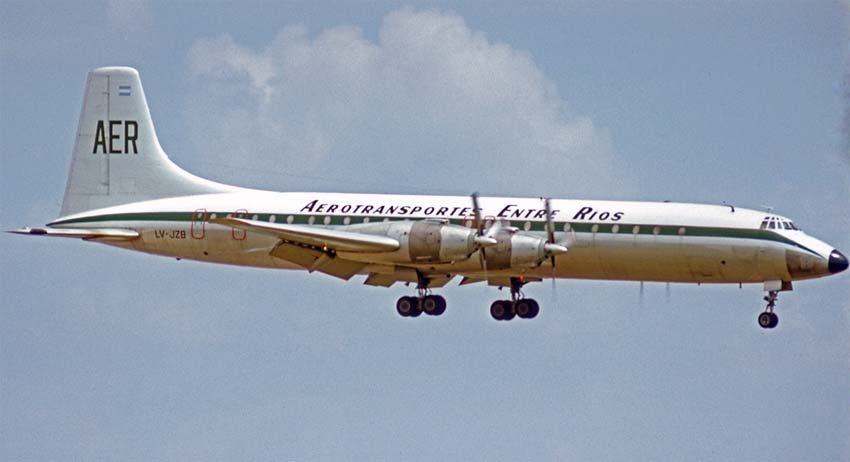
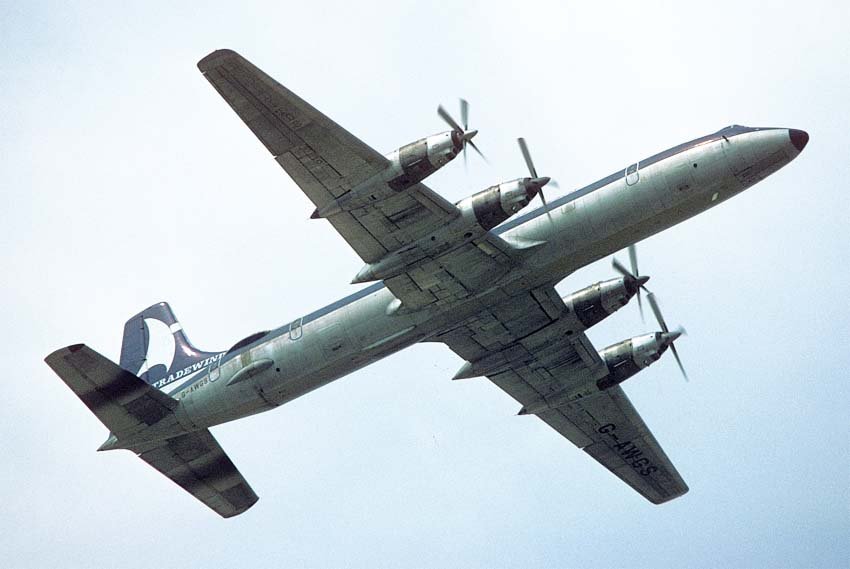
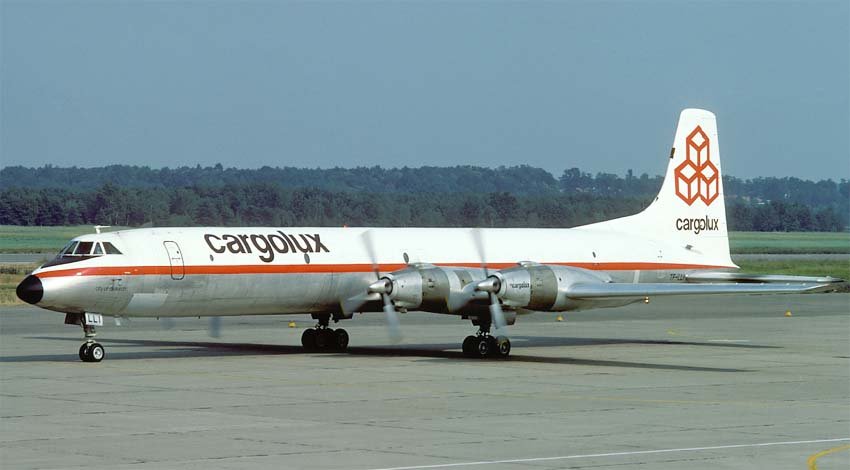
The Bristol Britannia aircraft served as the conceptual and technical inspiration for “Canadair” in creating the CL-44, which was initially conceived as a cargo plane. The aircraft was successful and remained in operation into the 1990s.
The history of the Canadair CL-44 began in 1952, when the Royal Canadian Air Force (RCAF) started searching for a new maritime patrol and anti-submarine aircraft to replace the Avro Lancaster. Ultimately, in 1954, a license agreement was concluded between “Canadair” and “Bristol Aeroplane Company” for the development and production in Canada of a modified version of the four-engine Bristol Type 175 Britannia airliner.
The new CL-28 Argus maritime patrol (reconnaissance) aircraft received the wing, tail assembly, and landing gear from the Britannia airliner (modified to accommodate weapon hardpoints), combined with a new unpressurized fuselage featuring a weapon bay. Instead of Bristol Siddeley Proteus turboprops, the aircraft was fitted with four R-3370-RC981 Turbo-Compound piston engines, each producing 3700 hp. The Argus prototype first flew on March 28, 1957, followed by 12 Argus I aircraft and 20 Argus 2 aircraft, which were operated exclusively by the RCAF.
The CL-44 in Service and its Evolution
Additionally, work was underway on a long-range transport variant, which received the designation CL-44. In the spring of 1957, “Canadair” received a contract to build eight CL-44s for the RCAF, with an additional prototype of the cargo variant featuring a loading door in the tail section also contracted.
The CL-44 received the wing, tail assembly, and landing gear from the Britannia, although the structure underwent local reinforcement due to the new aircraft’s higher maximum takeoff weight. The Britannia 253 fuselage was extended by 3.76 m and remained pressurized. “Canadair” proposed three power plant options for the CL-44: Bristol BE25 Orion, Pratt & Whitney T34, and Rolls-Royce Tyne. The RCAF selected the Orion variant. However, in 1958, after production of this engine ceased at “Bristol Siddeley,” the first production aircraft, the CL-44-6 (Canadian military designation CC-106 Yukon), was fitted with Tyne II engines, each producing 5500 hp.
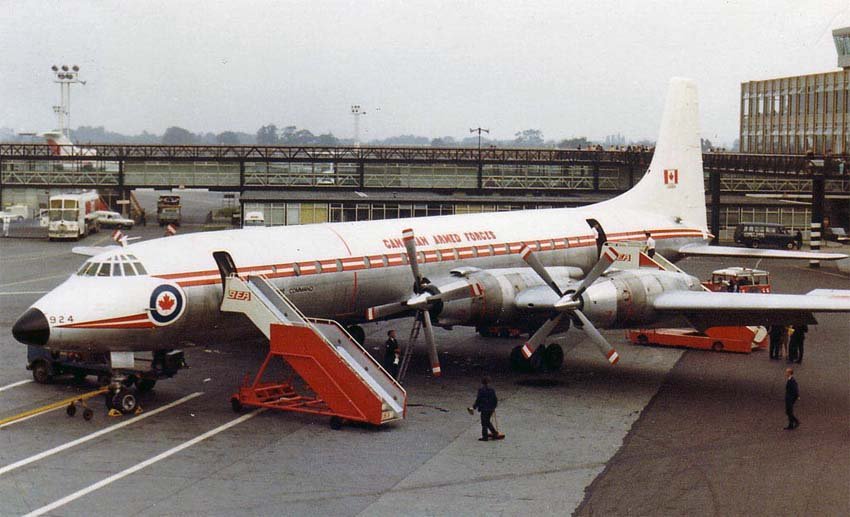
The aircraft had two sliding cargo doors on the left side, forward and aft of the wing, and could carry 27,525 kg of cargo. The prototype made its first flight on November 15, 1959, piloted by test pilots W. S. Longhurst and MacLean. The RCAF received 12 CL-44-6/CC-106 aircraft in the early 1960s; nine of these were purely cargo and assigned to the 437th Squadron, while the others were used by the 412th Squadron as passenger aircraft. The RCAF decommissioned its Yukons starting in 1973, and all were acquired by cargo airlines, primarily from Latin America.
The Innovative Swing-Tail Design
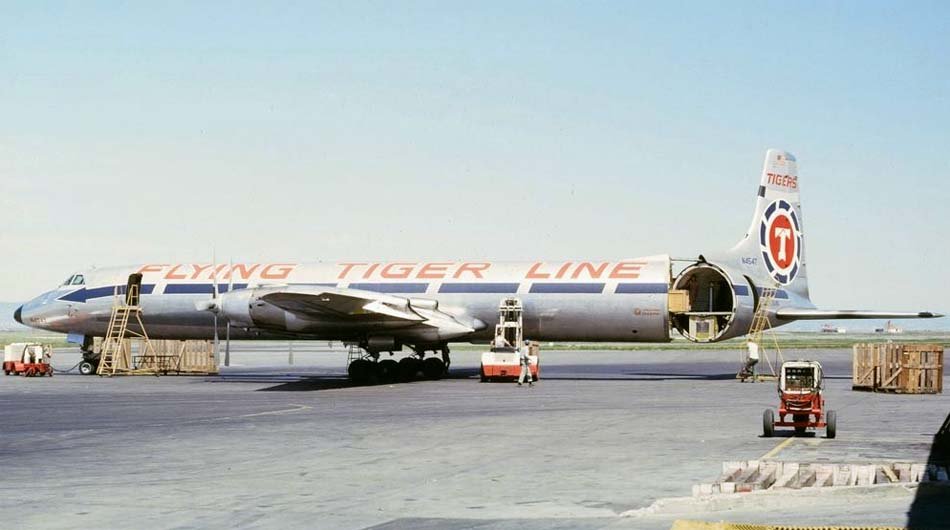
Soon, “Canadair” concluded that the side sliding cargo door was not the best option for quick loading (and unloading). As a result, it was decided to implement a variant of unloading through a fuselage tail section that swung open sideways. This allowed for easy loading/unloading of any, even oversized, cargo, as well as offloading directly from trucks without the use of cranes.
The CL-44D4 variant, also known as the Canadair Forty-Four and externally similar to the CL-44-6 (excluding the rear sliding cargo door and the use of Rolls-Royce R.Ty.12 Tyne 515/10 engines), received a swing-tail section from “Canadair,” equipped with a hydraulic drive (it swung open to the right, with the joint in the area of the dorsal fin). Full opening took only 90 seconds, normal operation was allowed with crosswinds up to 13.3 m/s, and in the open position, the tail section could remain even with wind gusts up to 26.6 m/s. In the closed position, it was automatically secured by eight locks.
The aircraft’s main cargo cabin had a length of 30 m, a width of 3.35 m, a height of 2.05 m, and a volume of 178.6 m³. Below it was an additional cabin with a volume of 28.3 m³. The total mass of transported cargo reached 28,725 kg. The CL-44D4 had a standard crew of 3-4 people. Pilots had access to a VOR system, radio compass, radio altimeter, and glideslope indicator. Control of the rotating tail section was performed by an operator from a console located at the rear of the aircraft directly at the joint.
Commercial Success and Adaptations
The first CL-44D4 (CF-MKP-X) took to the air on November 16, 1960, and seven months later received certification from the US Federal Aviation Administration. “Canadair” initially received orders for 17 aircraft, then the order book grew to 23 aircraft from three American air freight carriers: “Flying Tiger Line,” “Seaboard World,” and “Slick Airways.” The first delivery was made on May 31, 1961, to “Flying Tiger.” At that time, these companies were the largest in the world involved in air freight, so they quickly appreciated all the advantages of the new aircraft: speed, payload, simplicity, and operational economy. Its superiority over the Douglas DC-6 and Lockheed Constellation was obvious.
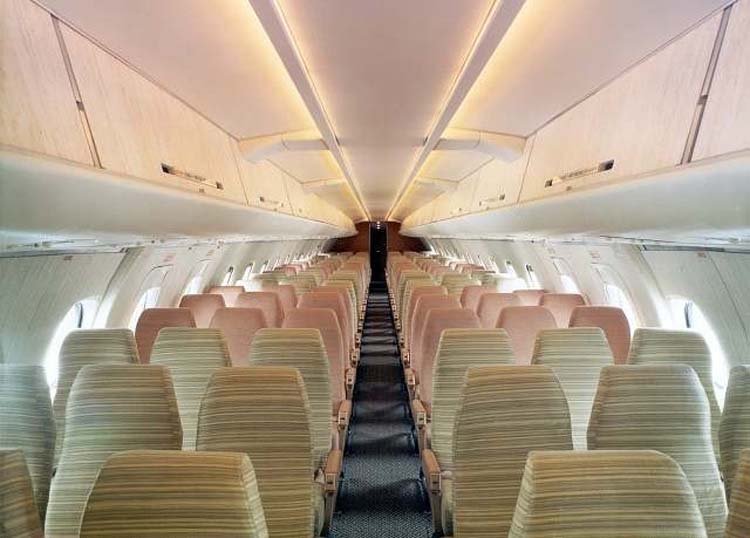
“Canadair” also developed a military transport aircraft variant with tail loading—it received the designation CL-44G and was intended for the Canadian Department of National Defence, but no orders followed. Another customer for the aircraft was the Icelandic company “Loftleidir,” which placed an order for four aircraft in the CL-44D4-8 passenger airliner variant with a capacity of 160-178 passengers, planned for use on transatlantic routes. The aircraft retained the ability to use the rotating tail section, but the hydraulic system was dismantled.
Specialized Variants: Passengers and Bulk Cargo
The last development by “Canadair” was the CL-44J variant, created to meet “Loftleidir”‘s requirements for a higher-capacity airliner. “Canadair” converted the fourth of the CL-44D4-8 aircraft ordered by “Loftleidir” and the last of the 39 CL-44 aircraft built by the company into an increased-capacity airliner—by extending the fuselage by 4.6 m, the passenger cabin capacity was increased to 214 seats. The aircraft made its first flight on March 17, 1965, in the CL-44D4-8 standard, and the modified variant, CF-SEE-X (CL-44J prototype), made its first flight on November 8, 1965. The other three CL-44D4-8 aircraft owned by “Loftleidir” were also converted to the CL-44J standard, but the developer’s plans to launch the extended version of the aircraft into series production under the designation Canadair 400 were not realized.
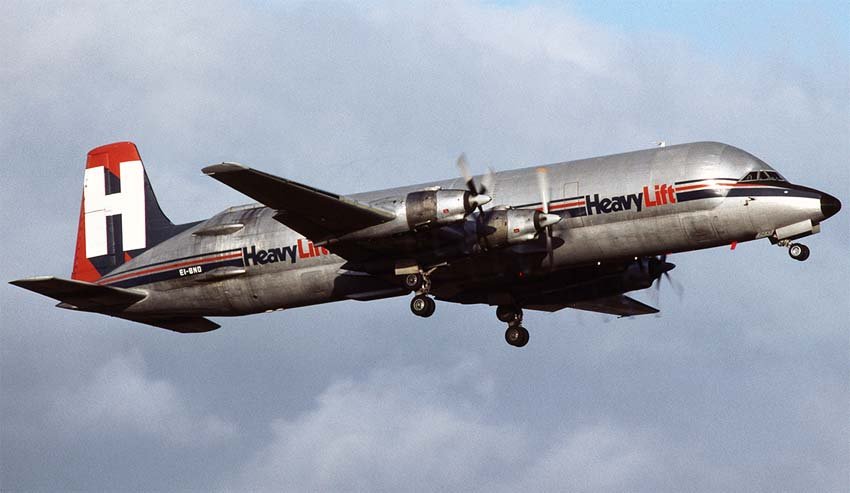
Another CL-44 variant was a “hybrid,” derived from a CL-44D4 aircraft previously owned by “Flying Tiger Line.” The “Conroy Aircraft Company” converted it into a cargo aircraft for transporting oversized cargo. The owner of this company, Jack Conroy, is known for his projects converting production aircraft models such as the Boeing 377 Stratocruiser and KC-97 Stratofreighter into aircraft for transporting oversized cargo (the converted machines received the designations Guppy, Pregnant Guppy, Mini Guppy, and Super Guppy).
The CL-44D airframe remained almost unchanged, but immediately behind the cockpit, the upper part of the fuselage was completely dismantled and replaced with a convex structure, thereby enabling the transport of oversized cargo in the cargo cabin. The aircraft received the designation CL-44-O; it made its first flight in 1969 piloted by the famous “Lockheed” test pilot Herman Salmon. The aircraft transported Rolls-Royce RB.211 engines and nacelles from the United Kingdom to California as part of the Lockheed L-1011 TriStar program.
Technical Specifications
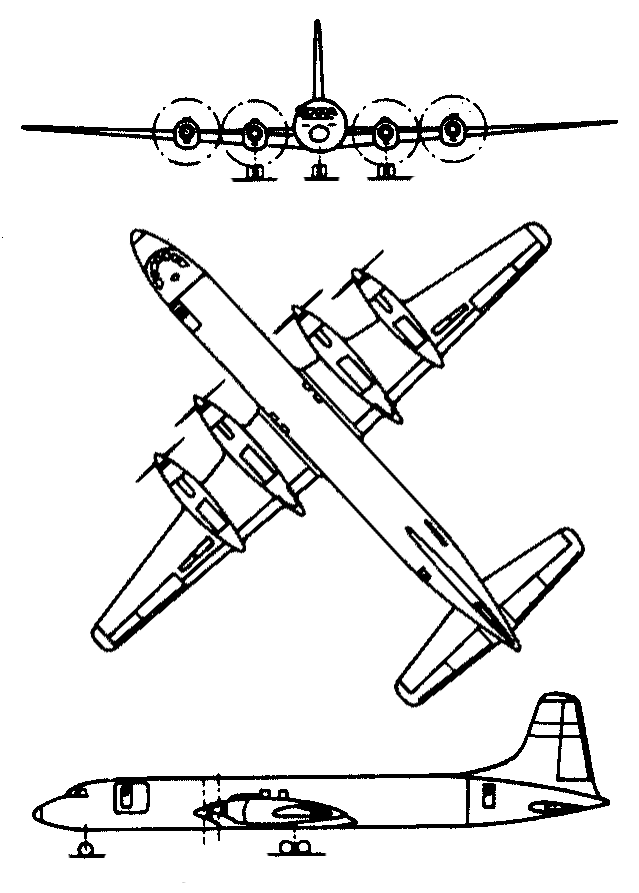
| Modification | CL-44D4 |
| Wingspan, m | 43.37 |
| Length, m | 41.73 |
| Height, m | 11.18 |
| Wing area, m2 | 192.77 |
| Empty weight | 40348 kg |
| Maximum takeoff weight | 95000 kg |
| Internal fuel, kg | 36944 |
| Engine type | 4 Rolls-Royce Tyne RTy.12 Turboprops |
| Power, ehp | 4 x 5500 |
| Cruising speed, km/h | 646 |
| Practical range, km | 8990 |
| Range with maximum payload, km | 3798 |
| Service ceiling, m | 9145 |
| Crew | 3-4 crew |
| Payload | up to 160 passengers or 134 soldiers or 27434 kg of cargo |
Image gallery of the Canadair CL-44