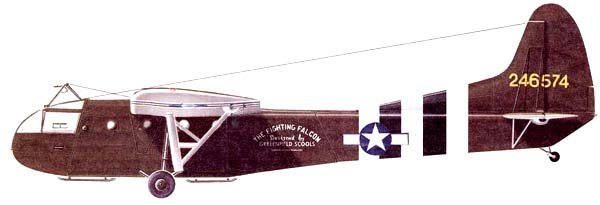
The US War Department began considering the use of gliders in airborne operations even before the country entered World War II. In 1941, after brief discussions, requirements were developed for two types of transport and assault gliders. According to these requirements, the first type of glider was to carry 8-9 fully equipped soldiers.
Contracts for building prototypes to participate in the competition were awarded to “Frankfort” (glider designation – XCG-1), “Waco” (XCG-3), “St. Louis” (XCG-5), and “Bouvlas” (XCG-7). The second option envisioned a larger aircraft with a cargo and passenger cabin for 15 people, allowing for the transport of certain military equipment.
The same firms undertook the construction of prototypes for this specification; “Frankfort’s” heavy glider project was designated XCG-2, “Waco’s” XCG-4, “St. Louis’s” XCG-6, and “Bouvlas’s” XCG-8. Notably, none of the leading US aircraft manufacturers like Boeing, Douglas, or Curtiss were interested in building unpowered aircraft.
Of the eight projects, only XCG-1, XCG-2, and XCG-6 were built and tested, but for several reasons, they were rejected by the War Department and not transferred to serial production. Only two prototypes, produced by the hitherto almost unknown “Waco” firm from a small town of the same name in Texas, were selected for further development.
One of them, the XCG-4, designated CG-4A, later became the most mass-produced assault glider of World War II. It is now difficult to determine what explained this choice. Perhaps the customer favored the simplicity and low cost of the design, based on the use of readily available materials, while offering perfectly satisfactory flight data.
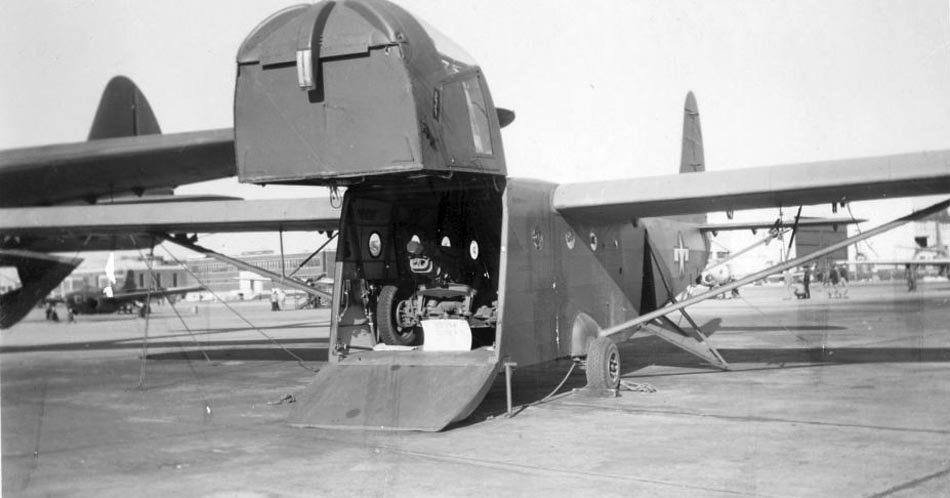
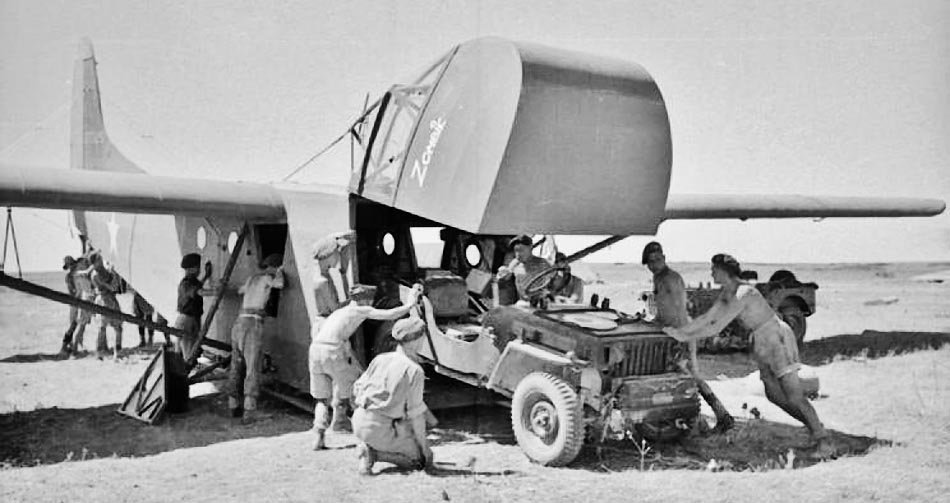
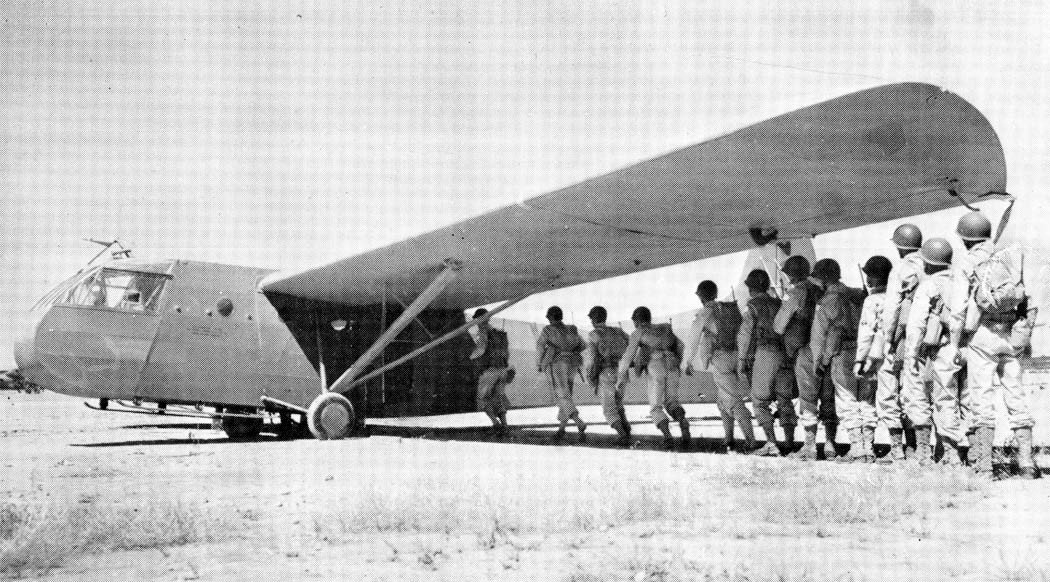
The CG-4A glider was intended to carry 15 fully armed soldiers, including two pilots. Instead of personnel, it could carry a standard “Ford” or “Willys” army jeep with a 250 kg load and four paratroopers, or a 75mm howitzer with its crew and several shells, or a 40mm Bofors anti-aircraft gun. It could carry any other suitable cargo weighing up to 1850 kg. The towing speed was set at 220 km/h, allowing the use of C-46 and C-47 transport aircraft as tugs.
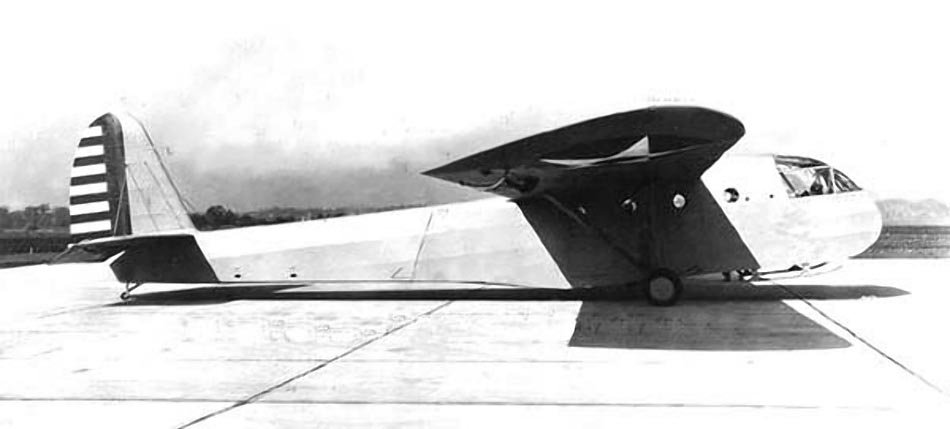
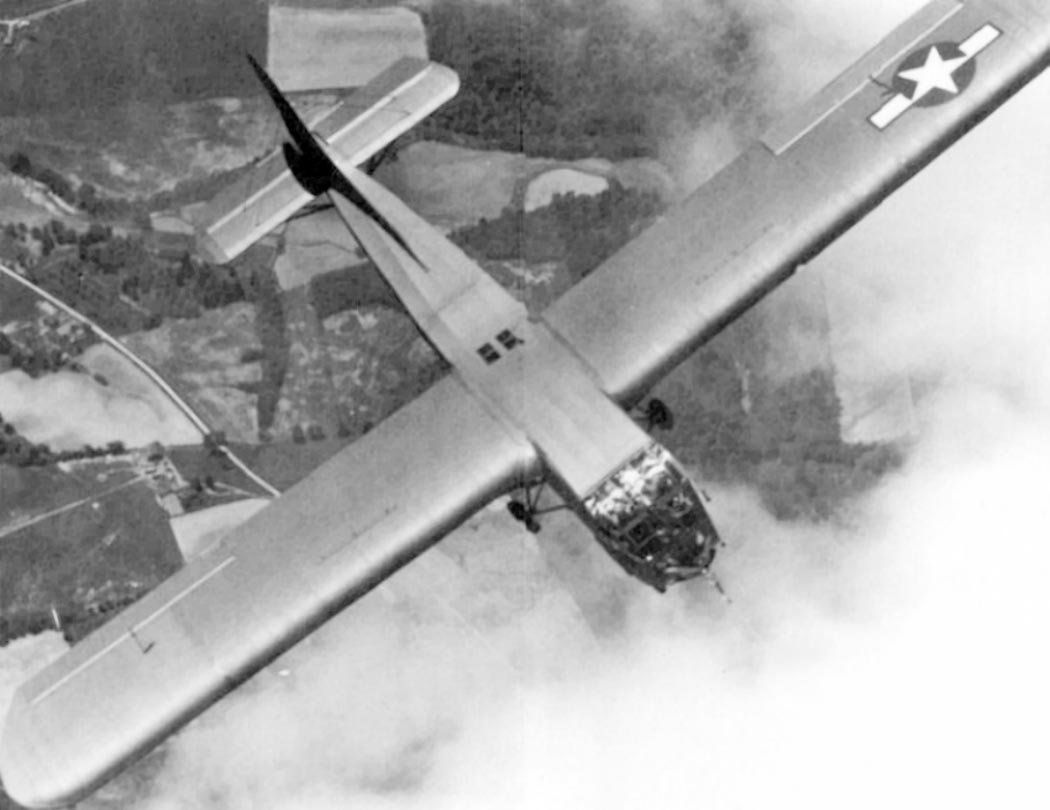
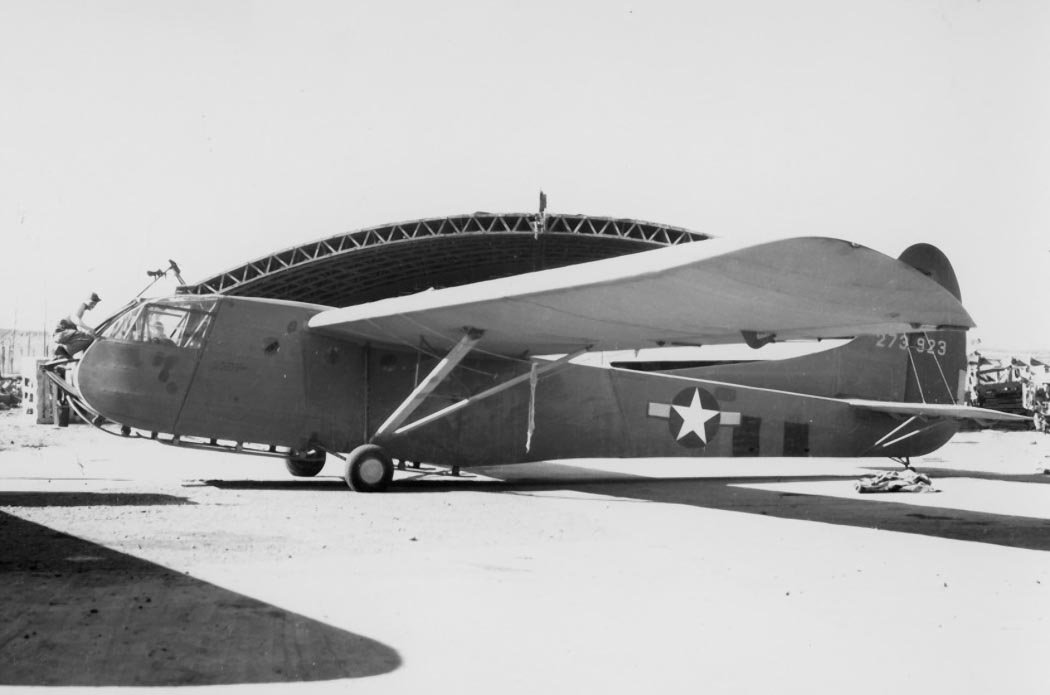
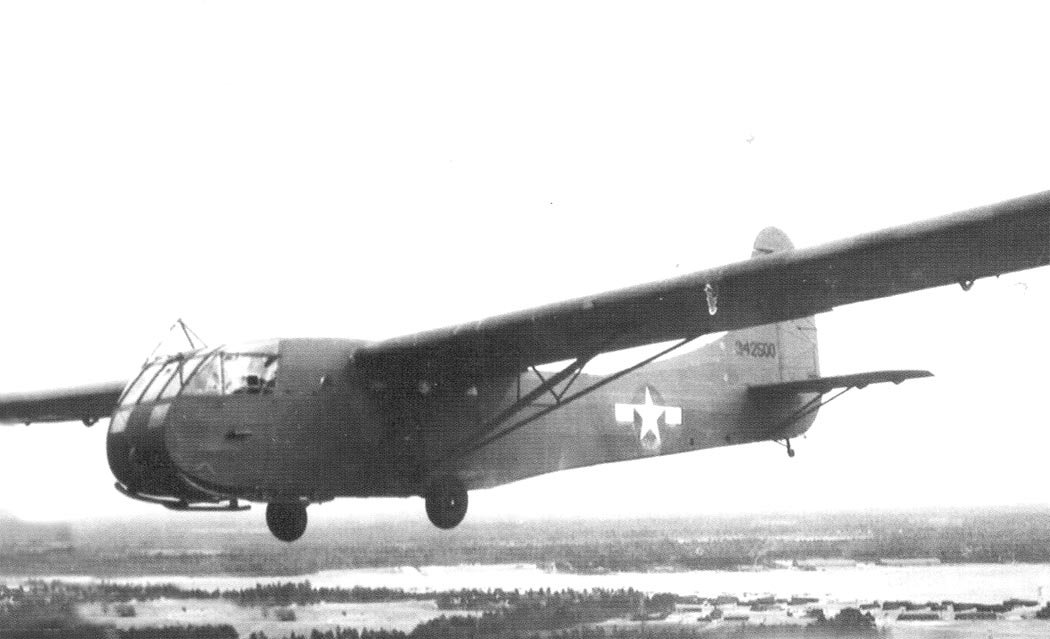
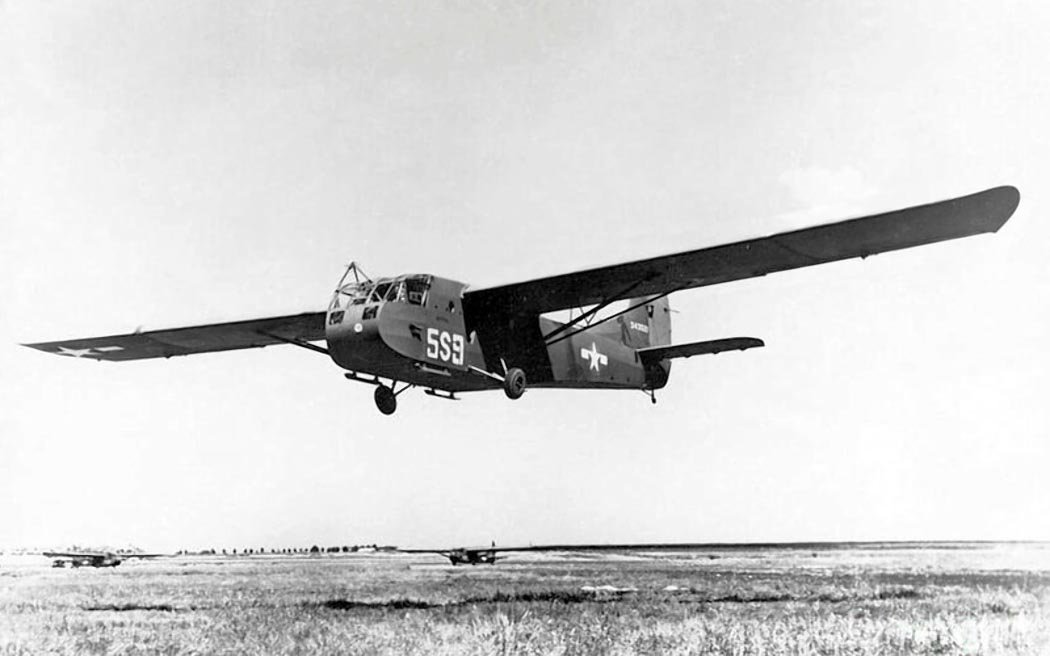
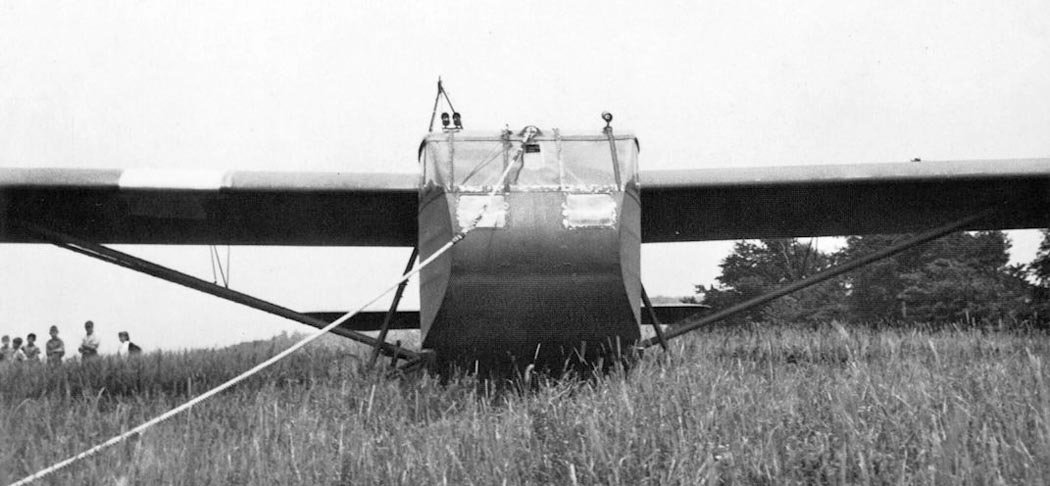
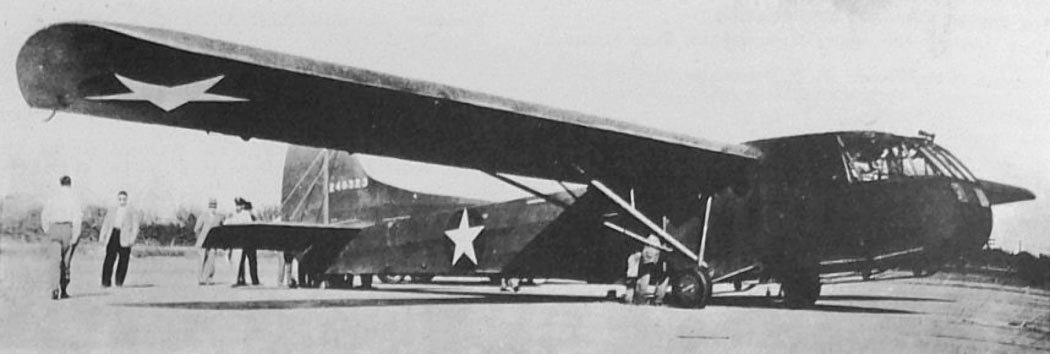
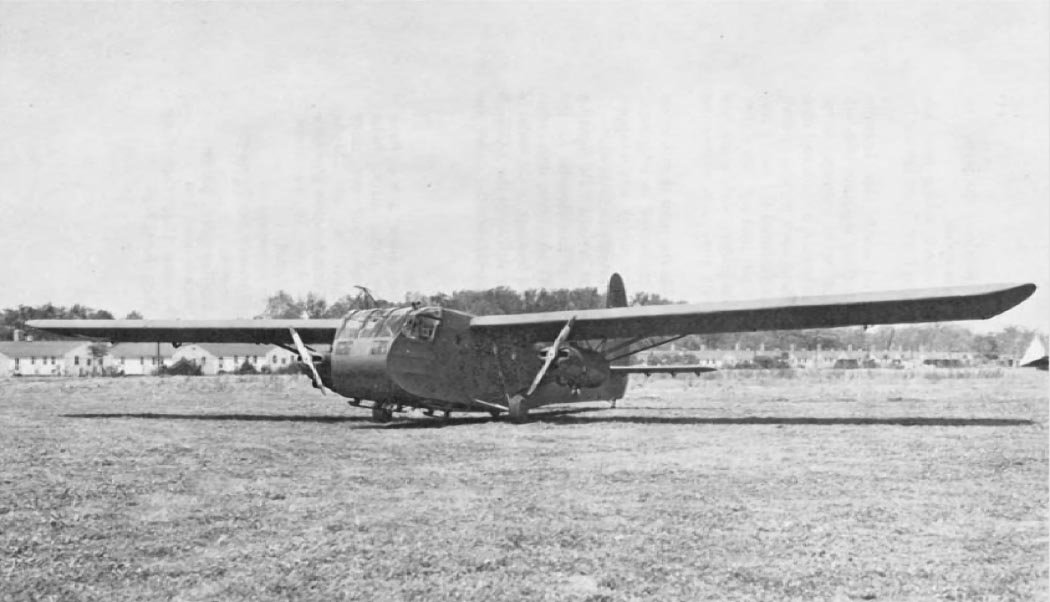
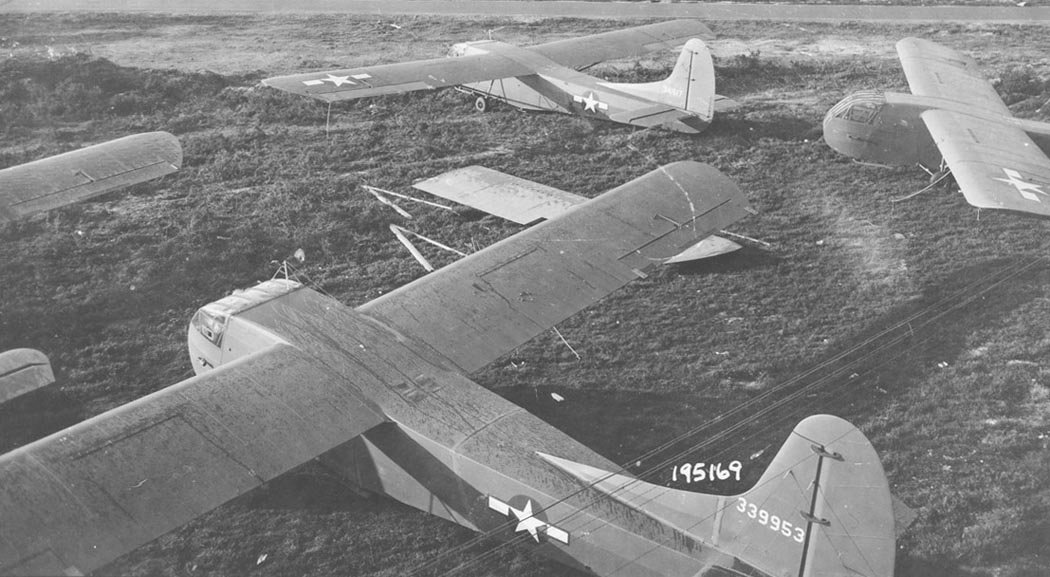
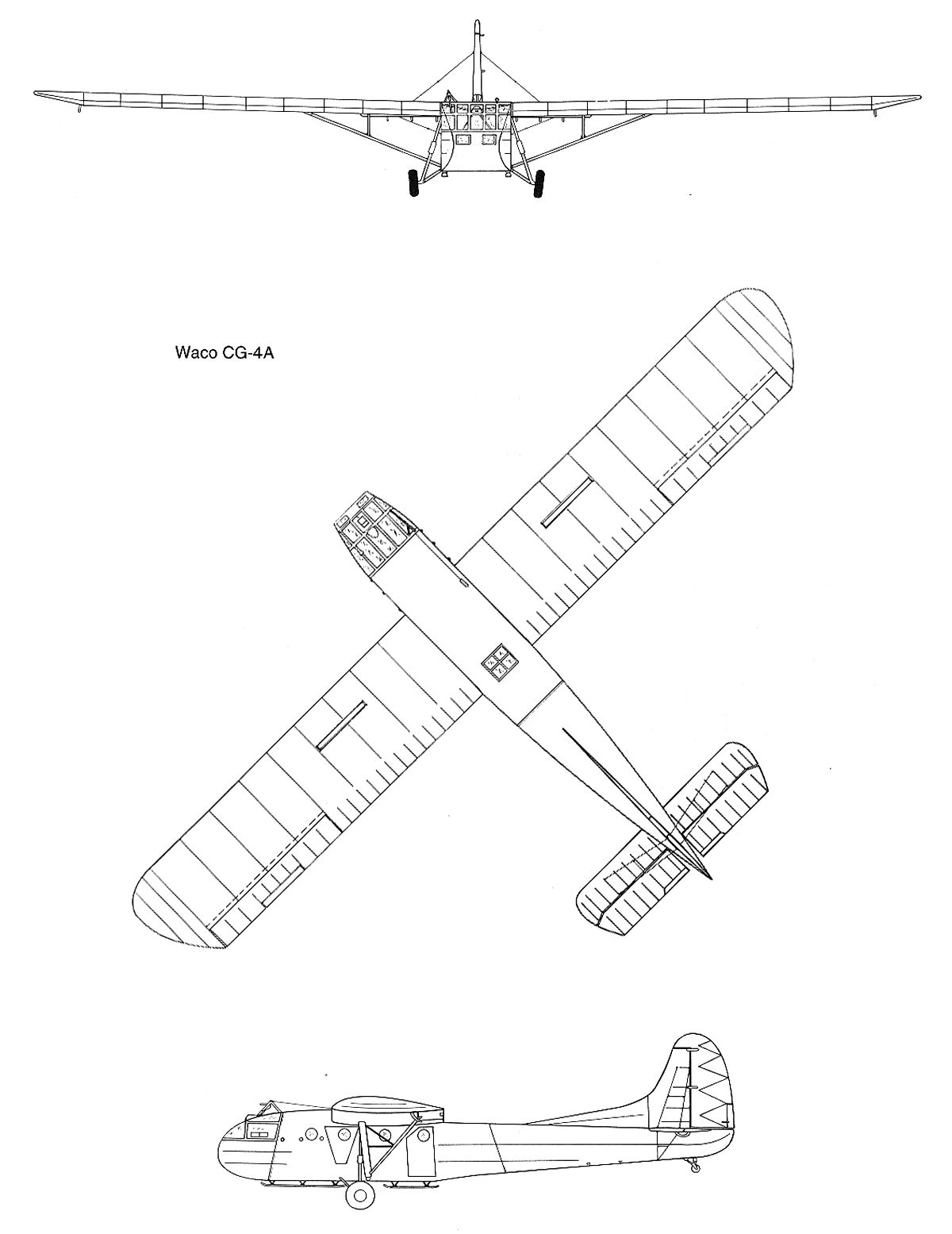
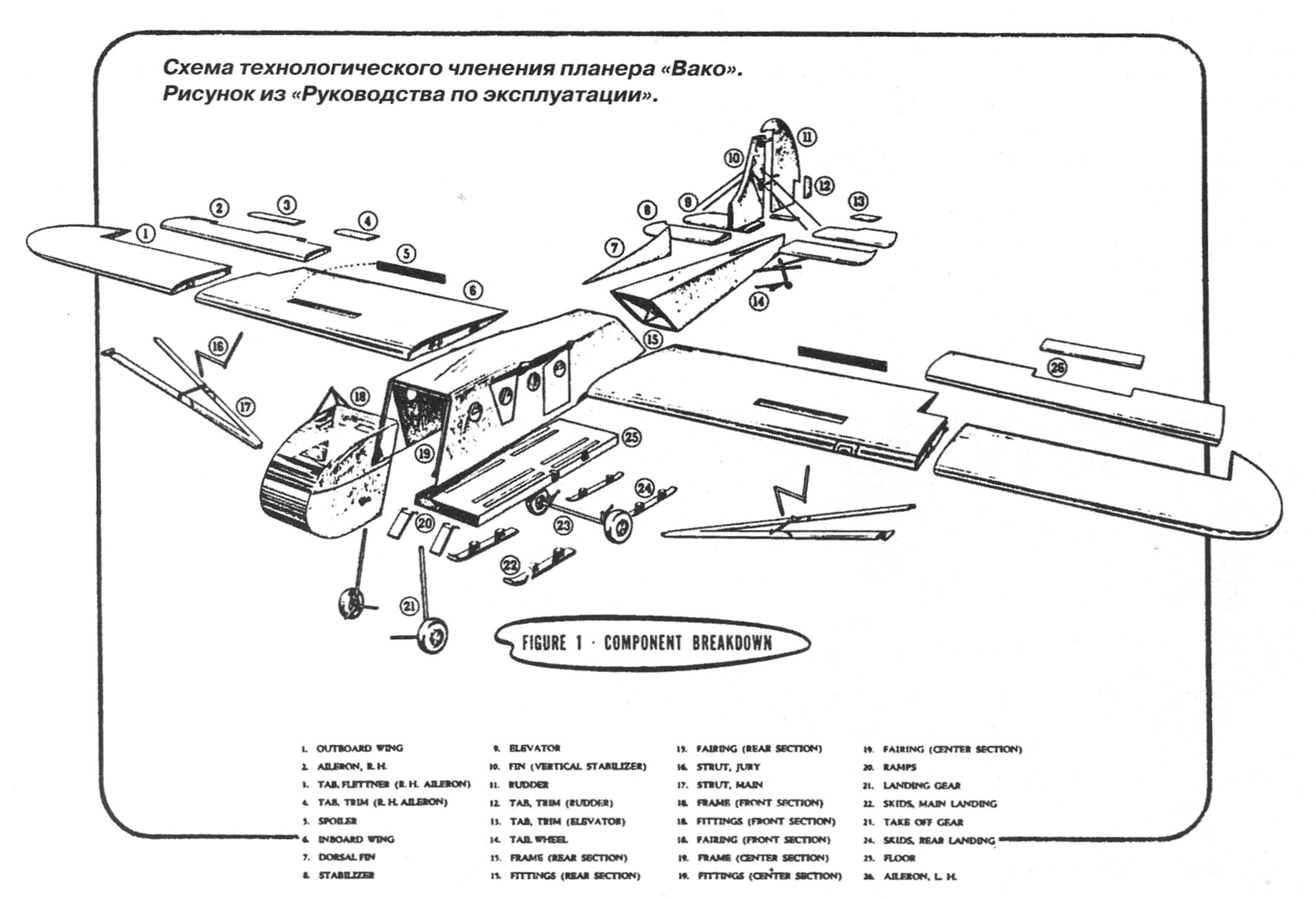
The requirement to transport a jeep largely determined the glider’s design. For loading and unloading the vehicle, the nose section of the fuselage, including the cockpit, was made to hinge upwards. Aerodynamically, the CG-4A was a braced high-wing monoplane. The fuselage frame, of rectangular cross-section, welded from steel tubes, consisted of three parts.
Development and Design of the CG-4A
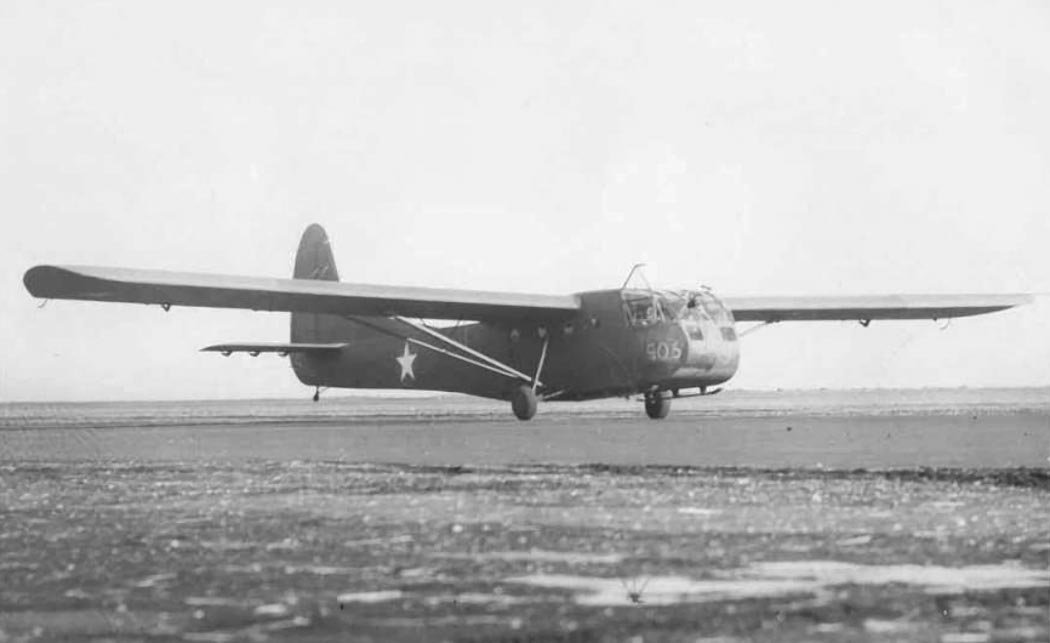
The nose section housed a two-seat cockpit for pilots sitting side-by-side. The cockpit had hinges at the top and latches at the bottom, allowing it to be swung upwards during loading and unloading operations. To facilitate lifting the cockpit, a special tubular pyramid was installed on its roof, from which a cable ran into the cargo cabin.
By pulling the cable with a hand winch, the cockpit could be raised and secured in the open position. A Pitot tube was also mounted on this pyramid. The cockpit had a fairly large glazed area, providing pilots with good visibility. The canopy frames were made of duralumin channels, with flanges facing outwards. Sliding windows were mounted on the side glazing surfaces. Sometimes a window was also placed on the front pane, or occasionally made in the form of a special “mushroom.” The cockpit floor was covered with plywood, and the sides with fabric. A Venturi tube was attached to the left side, and on some modifications, it was on the cockpit roof.
Plywood seats were attached to the frame for the pilots, and a plywood floor was beneath their feet. The frame tubes converged in a bundle at the front upper part of the cockpit, where the towing release mechanism and control column mounting brackets were located. This same bundle of tubes served as an anti-overturn frame, protecting the crew from cockpit crushing in the event of the glider overturning during a rough landing.
The middle part of the fuselage was the cargo compartment. It had a rectangular cross-section, formed by a tubular frame. The cargo floor was made of wooden beams, covered top and bottom with plywood. The floor had fasteners for installing removable paratrooper seats and loops for cargo lashing. Brackets for attaching the landing gear, main wing strut, and landing skids were located on the underside and sides of the fuselage.
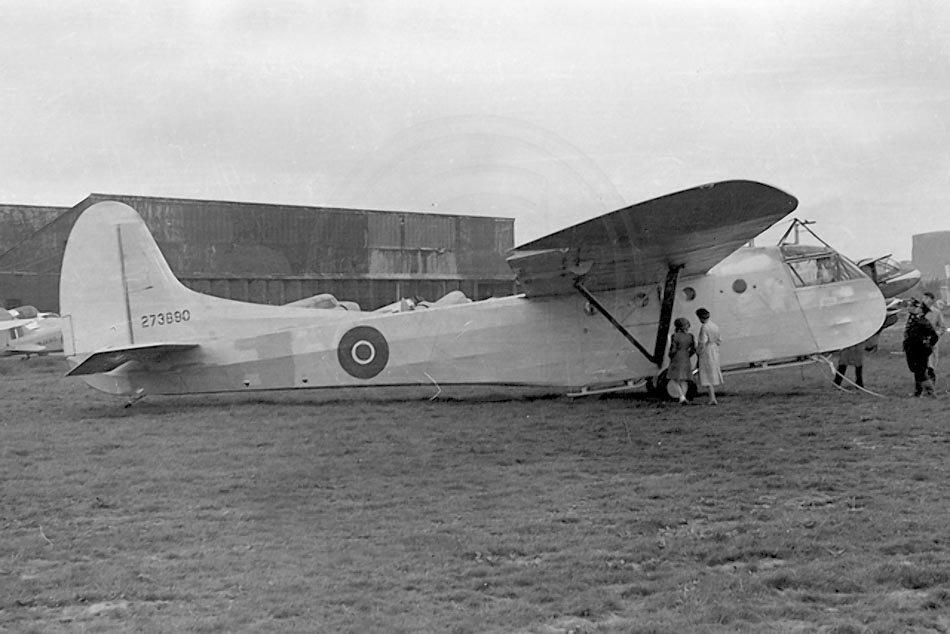
Wing attachment points were located in the upper part of the cargo compartment. An entrance door, an emergency hatch, and four round portholes were cut into each side. Ventilation “mushrooms” were placed next to the portholes. On the ceiling, near the wing’s trailing edge, two additional skylights were arranged. All surfaces, except the cockpit floor and bottom, had fabric covering.
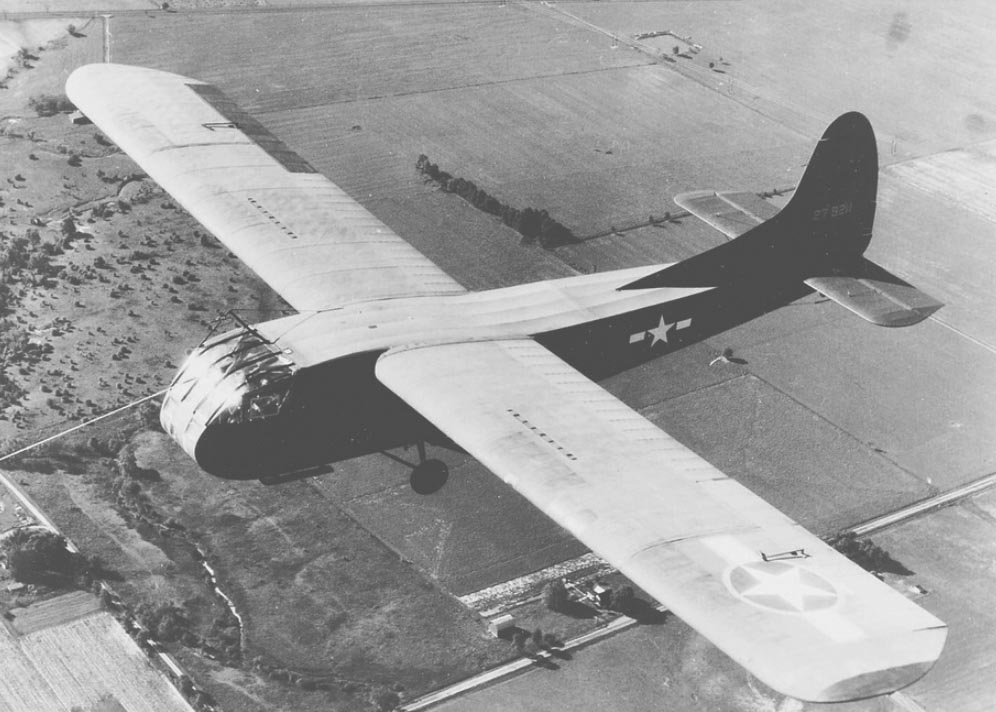
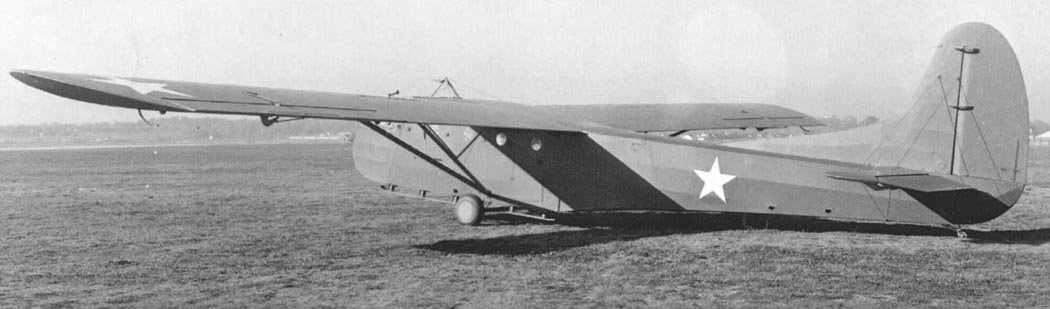
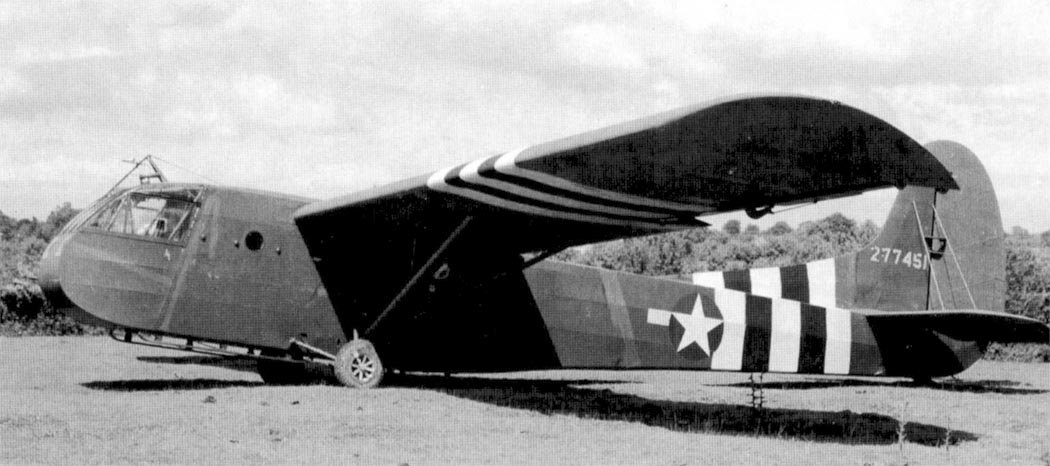
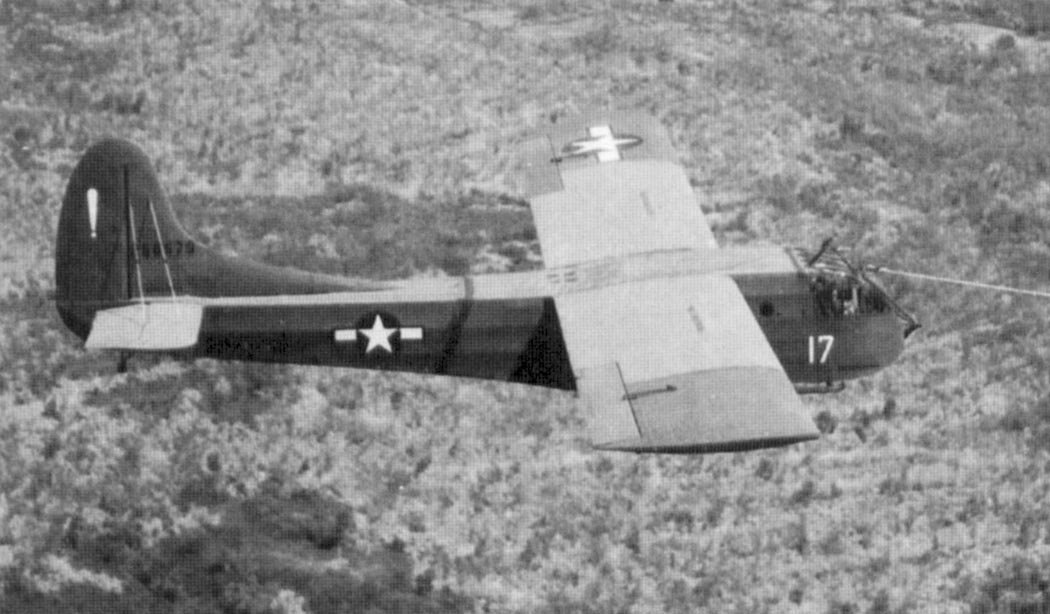
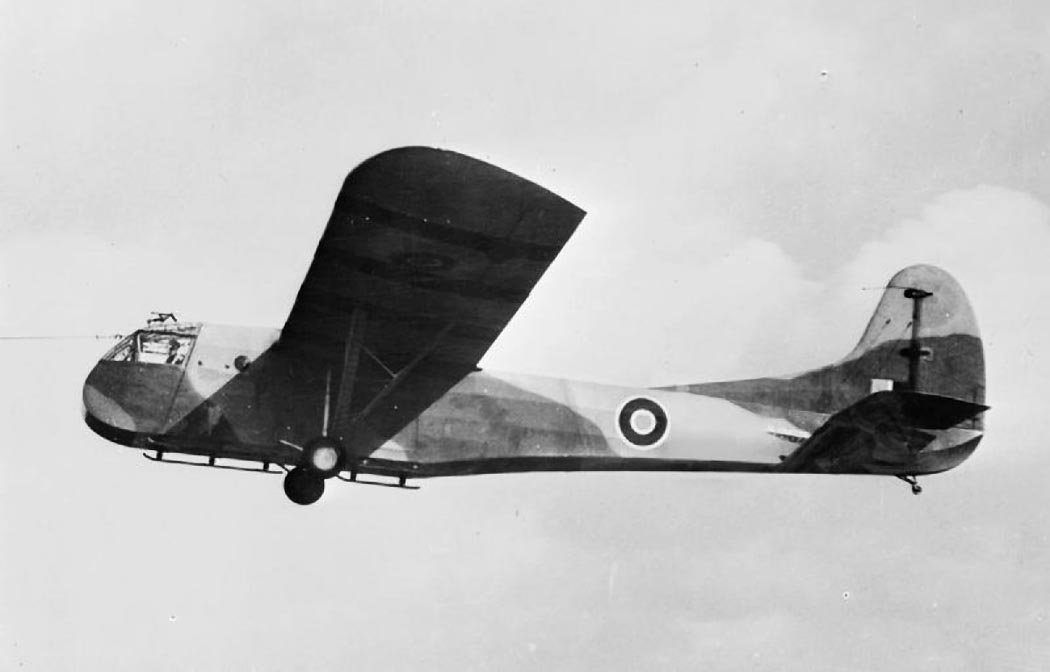
The tail section of the fuselage was a spatial truss, rectangular in cross-section, welded from tubes and covered with fabric. It had attachment points for the stabilizer, fin, and tail wheel. The wing was rectangular with rounded tips. It was attached to the upper part of the fuselage and supported by a main V-strut and an additional N-strut. The struts were made of steel tubes, with the strut tubes covered by fairings to improve aerodynamics, consisting of wooden ribs, a trailing edge, and fabric covering. The wing’s incidence angle was +1.50°, and the transverse “V” angle was also +1.50°. The NACA-43012 profile was chosen for the wing, which has a characteristic “beak” at the leading edge and shows good performance in gliding flight and during towing.
The wing was entirely wooden. The structural frame consisted of main and auxiliary spars, plywood truss ribs, and plywood skin over most of the surface. Only small areas near the trailing edge and wingtips were covered with fabric. Landing flaps were absent on the wing, explained by the low wing loading. Ailerons, equipped with trim tabs and consisting of a duralumin frame and fabric covering, were located on the trailing edge. A small rotary interceptor was installed on the upper surface of the wing. Since airborne assaults were planned for both day and night, a powerful landing light, powered by a battery, was placed on the leading edge of the left half-wing.
The classic tail assembly consisted of a fin and a stabilizer. The stabilizer was supported by V-struts, and from above, by wire bracing. The stabilizer, elevator, and rudder had a duralumin frame and duralumin skin along the leading edge. The remaining surfaces were covered with fabric. The control surfaces were equipped with aerodynamic compensation and trim tabs. The fin and dorsal fin consisted of a wooden structural frame and plywood skin.
The landing gear included main wheels, a tail wheel, and landing skids. Early models had jettisonable landing gear, consisting of two main wheels with a common axle running under the fuselage. Later, a fixed landing gear was installed, its strut consisting of a V-shaped rocking bracket, hinged to the cabin floor, and an air-oil shock absorber, secured in the upper part of the fuselage. The main wheels, sized 680×205 mm, were equipped with brakes.
The tail wheel was self-steering and equipped with an air-oil shock absorber. For some reason, in this aspect, the designers decided to depart from their stated simplicity and cheapness, although a much cheaper rubber bungee shock absorber could have been used. The wooden landing skids had a three-layer construction. During operation, the weakness of the landing gear became apparent, so during production, the size and number of skids constantly increased. Thus, in the first series, only four small skids were under the fuselage, and later their number increased to seven, placed not only under the cargo cabin but also in the nose section.
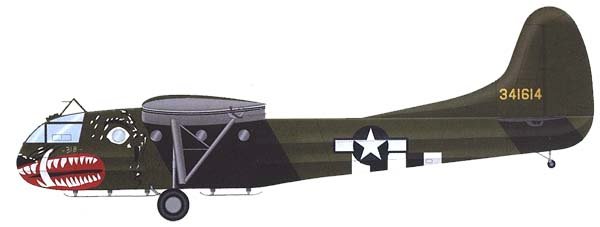
To protect the crew during landing from collisions with bushes, trees, and other obstacles, the glider’s nose was significantly reinforced during serial production. Strong steel tubes enveloped the cockpit and converged at a single point in the front, forming something like a ram. The towing hook was also installed there. This modification was named the “Griswold Nose.”
Technical Specifications and Innovations
The control system was of a classic cable-operated design. The cockpit housed a dual control column with round yokes and control pedals. Brake pedals were only available to the left pilot. Early series provided for telephone communication with the tug via a wire laid along the tow rope.
However, as the wire often broke in flight, wired communication was deemed unreliable, and a radio station began to be installed in the glider. This was for a single flight! I recall that at that time, radios were not even on all combat aircraft in the USSR. Still, the concepts of “simplicity and cheapness” were understood somewhat differently in the USSR and the USA in those years. The radio, as well as the landing light and navigation lights, were powered by a battery.
The flight navigation equipment consisted of an airspeed indicator, variometer, bank and slip indicator, altimeter, and compass, which theoretically allowed for independent flight after release and landing only during the day and in simple weather conditions. However, despite this, glider pilots in combat operations often landed their aircraft at night, even with such a meager set of instruments.
The CG-4A glider prototype first flew in May 1942. It quickly passed tests and was adopted for service. The government placed an order for a large series. The small “Waco” firm could not cope with the order independently and therefore involved at least 16 subcontractors in production, many of whom had not previously been involved in aircraft manufacturing. Of the 13,916 CG-4A gliders built between 1942 and 1945, the prime contractor, “Waco” itself, built only 1075 units.
Most of them were assembled at the company’s “Waco of Troy” plant in the obscure town of Troy, Ohio. The rest were made by partners. I will list only the largest of them: Commonwealth produced 1470 units, General Aircraft 1112, and North-West Aeronautical 1510 units. In 1945, an order was placed for another 5190 units, but it was canceled due to the end of the war. Of course, various firms made minor design changes during production, but “Waco” strictly monitored compliance with the main technical parameters.
The CG-4A glider had good aerodynamic quality and a low wing loading. This ensured good “flyability,” stability, and ease of control. During landing, the glider approached the ground at a small angle, which lengthened the landing distance and increased the likelihood of collision with ground obstacles. If the pilot tried to “hug” the aircraft to the ground, he approached the landing area at too high a speed, which also increased the risk of an accident.
To increase the glide angle, interceptors were installed on the upper wing surface, which were deployed before landing. However, the interceptor release lever in the cockpit was awkwardly placed, leading to occasional erroneous deployment. Furthermore, deployed interceptors caused some instability during landing. As it turned out, the interceptor area was insufficient, so on some later series of gliders, a braking parachute was additionally installed. It was also deployed before landing (causing the CG-4A to approach the ground on a steep glide path), and immediately before touchdown, it was jettisoned for a normal rollout. Landing speed in this case did not exceed 80 km/h.
Towing was usually done with a single towline, meaning one glider behind one tug. The relatively low takeoff weight of the “Waco” allowed one aircraft to tow two gliders at once. In this configuration, the CG-4As flew side-by-side, which required special skills and extreme caution from their pilots. To reduce the risk of collision, one of the towlines was made longer, so the gliders flew behind the tug in a staggered formation, one about 10-15 meters behind the other. Nevertheless, in operations in Burma and Germany, where this towing method was used, several mid-air collisions occurred, resulting in fatalities.
The maximum towing speed, as mentioned, was 220 km/h, but it was sometimes exceeded, which risked breaking the towline and jeopardizing the glider’s structural integrity. Standard tugs were American C-46, C-47, and C-53 transport aircraft. In the British air forces, the Armstrong-Whitworth “Albemarle” bomber was usually used as a tug, but for it, such a speed was too low, leading to pilot fatigue and frequent towline breaks.
Difficulties also arose during loading and unloading operations. For example, a loaded jeep occupied almost the entire fuselage volume, severely hindering pilots’ access to the cockpit. They had to enter through the rear door, then climb over the vehicle, and only then take their seats. In the event of a rough landing (which was not uncommon), the hinged nose often jammed. Then, large cargo could not be unloaded, as the CG-4A did not provide for the possibility of “jettisoning” the tail, like on the British “Horsa” glider. Sometimes, soldiers had to literally break open the nose cockpit to roll a jeep, trailer, or gun out of the fuselage.
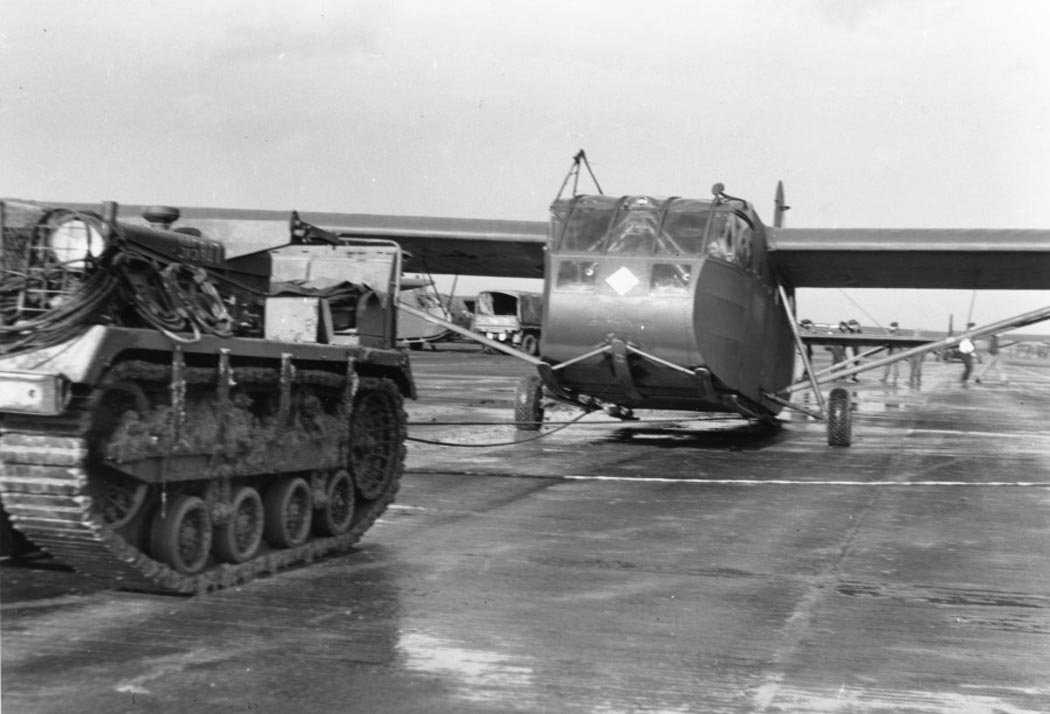
However, for the CG-4A, a “snatch” system was developed to retrieve the glider from the ground without the tug landing. If the glider was undamaged during landing, this system allowed it to be reused multiple times, and also to evacuate wounded personnel and crews from the landing zone. A special elastic towline was attached to the glider, the front part of which was formed into a loop. The loop was suspended in front on two poles 5-6 m high.
A hook with a latch and a cable was attached under the aircraft’s fuselage (usually a C-47). A special braking winch on the aircraft served as a device to dampen jerks and oscillations. During the snatch operation, the aircraft flew over the poles and hooked the rope loop. The latch engaged, securing the hook, and the tow cable unwound from the aircraft, braked by the winch while the glider performed its takeoff run. After the glider took off, the same winch reeled in the excess cable, and the flight continued as normal. This system was successfully used during combat operations in Burma.
Work on improving the glider continued during production. One of the subcontractors, the “Tim Aircraft Corporation” firm, built an all-wood version of the “Waco” in 1943, from whose design metal was almost entirely eliminated. However, this idea did not receive further development.
The “Waco” firm itself carried out a more radical modernization. Studying the experience of using the CG-4A, it created an improved version, which received the designation CG-15A. On the new model, the wing span was reduced, which allowed for increased towing speed, and to maintain an acceptable landing speed, the wing was equipped with flaps. The cockpit received a separate entrance door, and the landing gear had improved shock absorption. The glider was launched into production, and 427 units were built by the end of the war.
Repeated attempts were made to equip the “Waco” with engines. Thus, the “North-West Aeronautical” firm built four XPG-1 powered gliders (PG – Powered Glider). A Franklin engine with 95 kW (128 hp) was suspended under each wing. It was assumed that after completing the mission, the lightened glider without cargo would be able to take off independently and return to base on its own.
However, the engine power proved insufficient, so the serial version XPG-2A was fitted with well-cowled 147 kW (199 hp) Ranger radial engines with two-bladed propellers. Only 10 such gliders were built. The “Redfield” and “Ford” firms also built one powered glider each with the same engines, but their designs were rejected.
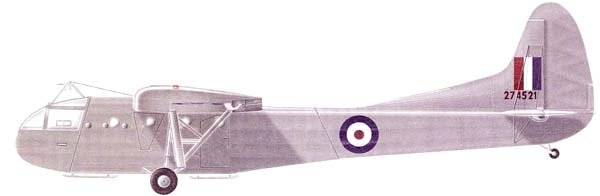
The Americans offered the CG-4A glider for purchase and licensed production to their British allies, but the British by then had a nearly ready, more capacious “Horsa” glider. Therefore, the British only bought 1062 CG-4A units, which they used in cases where heavy cargo transport was not required, for example, in reconnaissance and sabotage operations. The British, true to their tradition of giving their own names to all aircraft, named the glider after an ancient Roman emperor: “Hadrian.”
Combat Deployments and Operational Challenges
Beginning in 1943, the CG-4A was actively used in both Europe and the Far East. But the first event that made it famous was the record-breaking transatlantic flight of the “Waco.” The purpose of this operation was to deliver the glider to the British for familiarization and concurrently transport medical supplies, radio parts, and aircraft spare parts to Iceland and Scotland. A load of 1520 kg was placed on three pallets. For “insurance,” the glider was equipped with inflatable bags, which were intended to ensure buoyancy in case of a forced water landing.
On June 23, 1943, a C-47 tug and a CG-4A glider took off from the Canadian airbase “Dorval” near Montreal. The same day, they reached the northern coast of Labrador. On June 27, the combination flew to the forward airfield “Blue West One.” Three days later, the first phase of the transatlantic flight began. After 7 hours and 15 minutes, the glider and tug reached Iceland. There, two of the three pallets were unloaded from the “Waco,” and the combination set off for the second part of the transatlantic journey. On June 30, the crews successfully landed at “Prestwick” Airbase in Scotland. Thus, the first transatlantic flight of an unpowered aircraft in history was completed. The total flight time was 28 hours.
In actual combat operations, the CG-4A was first used during the Sicilian airborne operation. Due to a low level of training and poor management, the debut was a failure. On the night of July 9, 1943, 136 CG-4As took off from field airfields in Tunisia and set course for Sicily. The final destination of the route was the strategically important Ponte Grande bridge, which the paratroopers were to capture. On the approach to Sicily, the formations encountered heavy anti-aircraft fire and blinding searchlight beams. It was later found that American-British naval ships were firing, having mistaken the airborne assault for enemy bombers. To avoid unnecessary risk, the tugs released their charges several kilometers from the shore.
As a result, 69 gliders failed to reach the coastline and landed in the water. Seven of them are still listed as missing along with their entire crews, and the total number of missing (i.e., actually drowned) paratroopers was estimated at 207 people. Most of the remaining gliders landed anywhere but the target area, with many crashing into trees and stone walls. Only three “Wacos” out of 136 landed in the immediate vicinity of the bridge.
Nevertheless, the surviving American soldiers, together with their British counterparts who landed in “Horsa” gliders, quickly seized the bridge, which was almost unguarded. But two hours later, the Italians, recovering, counterattacked and recaptured the bridge without much difficulty. The total number of killed, wounded, and missing paratroopers and glidermen during this operation reached 600 people.
Another operation, codenamed “Fustian,” aimed to capture the Primafole bridge near the Sicilian city of Catania. For this, it was decided to use a parachute-glider assault, in which, besides paratroopers, eight CG-4As and 11 British “Horsa” gliders participated. On July 12, the formations departed from Tunisia. Two tugs with “Wacos” had to return due to technical malfunctions, and three more became victims of anti-aircraft fire. All other American gliders, as well as seven British ones, crashed during landing. Only four detachments of British paratroopers, who landed in the bridge area, completed the mission.
The CG-4A performed more successfully on the opposite side of the world from Europe—in Burma. The Japanese had occupied this British colony in 1942, driving out the British. But in 1943, the “Chindits”—British colonial troops, predominantly from the local population—under the command of General Wingate, began active retaliatory actions. Taking advantage of the lack of a continuous front line and the impassable nature of the terrain, they carried out deep jungle raids into Japanese rear areas, conducting sabotage, attacking garrisons and transport columns—in short, waging guerrilla warfare.
In January 1944, the British planned the largest of these operations. In total, over 20 “Chindit” battalions were to penetrate into the central regions of Burma and there destroy railway communications, sow chaos and panic. Their insertion was decided to be carried out by air, and this task was entrusted to an American air group under the command of Colonel Philip Cochran, which included transport aircraft and gliders.
The operation was codenamed “Tuesday.” It began with the insertion of parachute groups who cleared several landing sites for gliders in the Burmese jungles. In total, there were six such sites: “Piccadilly,” “Broadway,” “Aberdeen,” “White Town,” “Blackpool,” and “Chowringhee,” and they were quite far from each other. The distance from “Blackpool,” the closest site to the front line, to “Chowringhee,” the most remote, was almost 200 kilometers.
The construction of improvised airfields was completed by early March, but the first “Waco” glider landed in Japanese rear on February 28. It delivered 17 British commandos with orders to destroy an enemy communication node. Although the landing, as usual, was unsuccessful, and three paratroopers were wounded, the others successfully completed the mission.
The main phase of Operation “Tuesday” began on March 5. On the evening of that day, 44 British and 39 American C-47 transport aircraft took off from Indian airbases “Lala-ghat,” “Halekandi,” and “Tulihal.” Some carried paratroopers, others towed assault gliders. Some had to tow two gliders at once on dual towlines, although neither their crews nor the pilots of the gliders themselves were trained for this. As a result, several towlines broke, and two gliders collided in mid-air.
In total, 80 “Wacos” participated in the operation. The largest landing was planned for “Broadway.” 61 gliders were sent there, but during the nearly four-hour flight, nine of them returned due to technical problems with the tugs, eight broke away from their towlines and landed somewhere in enemy territory, and several more crashed in the jungle, just barely missing the strip.
Nevertheless, 37 CG-4A gliders successfully landed on “Broadway,” delivering 539 soldiers and officers, three mules, and almost 30 tons of various supplies, as well as construction equipment to turn a narrow jungle clearing into a full-fledged airfield. Only three aircraft crashed during landings directly on “Broadway,” with two killed and 35 paratroopers wounded. Compared to the previous year’s landings in Sicily, such a result could be considered magnificent. The paratroopers immediately began constructing a 1600-meter runway, on which 12 C-47 aircraft landed the very next night, delivering various cargoes and evacuating the wounded.
Another group of aircraft and gliders headed on March 5 to the planned crossing point of British troops over the Chindwin River. Six gliders landed there with soldiers who built a roadblock. The next day, March 6, 12 CG-4As flew to the “Chowringhee” site. Taking into account the negative experience of the previous landing, this time only single towing was used, and intervals between formations were increased. One of the gliders carried a small bulldozer for airfield construction, but this “wonder of technology” did not get to be tested in action: the glider crashed on landing, and the bulldozer was destroyed.
But already the next day, March 7, four more “Wacos” landed at “Chowringhee,” and one of them did deliver the precious micro-bulldozer. In just four hours, a new runway was built, and the first “Douglas” was able to land on it. Six undamaged gliders that landed at “Chowringhee” were evacuated by the snatch method and then reused. Interestingly, the pilot of one of them was the popular American comedic actor “Baby” Jackie Coogan, who had starred in several films with Charlie Chaplin before the war.
On March 21, six CG-4A gliders successfully landed at the “Aberdeen” site with bulldozers, military engineers, and equipment for building a runway. The next day, all of them also returned to base after being snatched. It should be noted that all these landings initially took place without any opposition from the Japanese. But, eventually, the enemy figured out what was happening, brought up forces, and launched a counterattack.
On March 23, five “Wacos” with ammunition landed at the “White City” site. At this time, a battle was underway on the approaches to the airfield with a large Japanese detachment attempting to seize it. Shells and mines exploded on the airfield, bullets whizzed through the air, but three gliders were quickly unloaded, then wounded were loaded into them, and the “Douglases” called by radio snatched them from the ground and towed them back to base. The other two gliders were “covered” by artillery fire.
On the same day, four gliders landed right “in the middle of the water,” on a sandy shoal of the Irrawaddy River, where they unloaded inflatable motorboats. With their help, the Americans set up a ferry crossing, which eased the Allied troops’ river crossing. Later, one of the four “Wacos” was successfully evacuated by the snatch method.
On March 25, under pressure from Japanese forces, the British had to evacuate from the “Broadway” airfield, and then from the “Aberdeen” and “Chowringhee” sites, but the other jungle airfields continued to operate. On May 17, 1944, Chinese troops, who had launched an offensive in northern Burma under the command of American General Stilwell, captured the Japanese airfield “Myitkyina.” The Japanese continuously counterattacked, and the general realized that he could not hold out without reinforcements. But troops could only be quickly transferred by air, and the airfield, due to its small size, could not receive transport aircraft.
Then glidermen came to the rescue again. On the morning of May 18, 10 “Wacos” with military engineers and equipment landed on the airfield. And although eight of them crashed, and several pilots and passengers died, the surviving engineer-soldiers immediately began uprooting trees, widening and lengthening the runway. And on the evening of the same day, the first “Douglas” with Chinese infantry landed on the “updated” Myitkyina airfield. Japanese counterattacks were repelled.
Meanwhile, at the end of May, the period of torrential monsoon rains began, halting combat operations for a long time. It was time to summarize the results. The Americans and British evaluated the performance of the gliders in Burma very positively. Unpowered aircraft proved to be an optimal means of delivering everything necessary for building airfields in the enemy’s rear, as well as for supplying military and partisan formations operating behind the front line. And the ability to snatch gliders from the ground made them also a good means of evacuation.
The climax of the “Waco’s” combat career was the famous Operation Overlord—the D-Day landings in Normandy, which opened the second front in Europe. In the first two days of this operation, 292 CG-4As were involved, landing troops of the 82nd and 101st Airborne Divisions in enemy rear areas near the towns of Sainte-Mère-Église, Sainte-Marie-du-Mont, and Les Forges.
The 82nd Division was dropped in four groups under the code names “Detroit,” “Elmira,” “Galveston,” and “Hackensack.” The first group, “Detroit,” consisted of 52 CG-4As, which headed for their designated area, located northwest of Sainte-Mère-Église. Troubles began soon after takeoff. Seven gliders over the English Channel detached from their tugs. The crews and passengers of only two of them were found and rescued from the water; the rest were lost.
As soon as they appeared in the landing zone, the formations came under heavy anti-aircraft fire. One of the tugs was shot down. Of the surviving 44 gliders, only 23 managed to land in the designated square; the rest were scattered around the area, and two aircraft crashed, hitting buildings in Sainte-Mère-Église. Many others suffered accidents during landings. Three people died, 23 were wounded, and a significant portion of the equipment was destroyed (including 11 out of 20 jeeps and eight out of 16 anti-tank guns).
The second group, “Elmira,” was mixed, consisting of 22 CG-4As and 54 British “Horsa” gliders with American crews. This group was also met by the Germans with intense anti-aircraft fire. In literally a few seconds, they shot down two “Douglases,” and the others hastily began to detach their gliders, caring only about getting out of the danger zone as quickly as possible. The designated landing site was no longer a concern. Glider pilots tried to “tuck” their aircraft wherever they could, on any suitable spot. In doing so, the relatively small and light “Wacos” were in a more advantageous situation than the heavy “Horsas,” which required a much longer landing distance. About half of the CG-4As landed safely, the rest suffered accidents. Among the “Horsas,” the number of completely destroyed aircraft reached 80%! But the gliders’ strong and well-thought-out design saved the lives of their crews; the number of fatalities was relatively small—five pilots and five passengers.
The third wave of assault, “Galveston,” began on the morning of the second day of the operation. It included 68 “Horsa” gliders and 82 “Wacos.” To reduce losses from anti-aircraft fire, the formations proceeded to the target at an extremely low altitude—from 60 to 100 meters—and at this same altitude, gliders detached from their tugs. Thus, glider pilots independently controlled their aircraft for no more than 30 seconds, during which they had to orient themselves and land. Of course, they had neither the altitude nor the time to choose a suitable landing site. For many of them, this brief thirty-second flight, more akin to a fall, remained their only combat sortie.
And this time, the “Wacos” again proved to be more “flyable” and safer than the “Horsas.” While 10 out of 68 British gliders crashed to pieces, burying 17 people under their wreckage, and another seven aircraft sustained serious damage, only nine of the 82 “Wacos” crashed, with no fatalities among them.
The last part of the operation to deliver the 82nd Airborne Division to the French coast, named “Hackensack,” began two hours after “Galveston” concluded. 70 “Wacos” and 30 “Horsas” transported elements of the 325th and 401st Glider Infantry Regiments, as well as 20 jeeps, 13 light field howitzers, six tons of ammunition, and 18 tons of various military equipment. On the edge of their landing zone, fighting with the Germans was still ongoing, who did not miss the opportunity to fire all weapons at the descending gliders. They did not manage to shoot down a single aircraft, but houses, poles, trees, and the very ground itself proved to be a far more dangerous enemy for the glidermen. 19 “Horsas” crashed (15 soldiers and two pilots killed) and 13 “Wacos” (two killed). Of the British gliders, only four landed undamaged, and of the American ones, 42. Two jeeps were also destroyed.
The 101st Airborne Division was dropped simultaneously with the 82nd, but in two waves, not four. The first landing party was called “Chicago.” It consisted of 52 CG-4As, carrying 158 soldiers and officers, 16 anti-tank guns, jeeps, ammunition, and equipment. They were to land on the morning of the first day of the operation a few kilometers west of the town of Sainte-Marie-du-Mont. The formations took off at night. Over the English Channel, they came under “friendly” fire from Allied naval anti-aircraft guns, which shot down one tug. The rest safely reached their target. At the moment of release, the moon disappeared behind clouds, and the ground was enveloped in impenetrable darkness, which only the yellow beams of the landing lights penetrated for a few tens of meters. Glider pilots had to land literally “by feel,” and the entire territory beneath them consisted of tiny fields, lined with poplars, surrounded by stone fences, and interspersed with rural houses.
It is not surprising that under such conditions, none of the gliders escaped damage, and several aircraft were smashed to splinters. Fifteen people died, including the division commander himself, Brigadier General Don Pratt. The “Waco” in which he flew was piloted by one of the best American glider pilots, Lieutenant Colonel Murphy, a multiple record holder. He did everything he could to save his life and the lives of his passengers, but when, during the rollout on slippery, dew-wet grass, a brick wall suddenly “emerged” from the darkness directly in front of the glider’s nose, all his skill and experience proved powerless… Don Pratt became the first American general killed in Normandy.
The second landing party, “Keokuk,” consisted of 32 “Horsa” gliders, carrying headquarters staff, medics, technical personnel, as well as 40 jeeps, six guns, and 19 tons of various supplies. Losses in this party were also considerable: 14 people died in crashed gliders, 30 were wounded, and 10 went missing.
In total, during the first two days of “Overlord,” American glidermen delivered 4021 soldiers and officers, 290 vehicles, several dozens of guns, and 238 tons of equipment and ammunition to the European continent. The paratroopers attacked German troops from the rear and cut their supply lines, which greatly eased the task of those who landed on the beaches of Normandy from the sea under heavy fire.
Human losses during the landings of the 82nd and 101st Divisions amounted to 463 killed and missing, to which must be added 25 killed and 50 missing glider pilots. This does not account for the losses of paratroopers in the intense ground battles that followed the landing. I want to emphasize once again that among the crews and passengers of “Waco” gliders, the percentage of losses was much lower than in “Horsas.” Thus, the American glider proved to be “more humane,” but the “Englishman” was more capacious and had a higher payload, and as is known, everything has a price. And in war, this price is often paid in human lives…
The next major operation involving the “Waco” was the Allied landing on the Mediterranean coast of France (Operation Dragoon). For this, a group of troops was formed, consisting of the 2nd American Airborne Brigade and the 550th Glider Infantry Battalion, totaling 2700 men. Early in the morning of August 15, 1944, 75 “Douglases” took off from southern Italy, towing 40 CG-4As and 35 “Horsa” gliders.
As the formations had already flown over Corsica, the American General Williams, commanding the operation, received a weather report for the landing zone. The weather was clearly unfavorable, with thick fog covering the ground. Under such conditions, the general deemed the landing of the heavy “Horsas” with their long landing run too risky and ordered the aircraft towing them to turn back. But he trusted the “Wacos” more and did not give them such an order. 40 formations continued their flight to the target.
Two gliders detached from their tugs for unknown reasons and ditched in the water. The crew and passengers of one were saved by a passing American ship, but the second was never found. Another pair had to return due to tug engine problems. The long journey over the Mediterranean Sea for the remaining 37 formations continued for four hours, but when they finally crossed the coastline and reached the designated square, a white haze continued to swirl over the ground. However, by all indications, it was expected to dissipate soon. The tugs had fuel reserves, and they decided to wait.
For almost an hour, the “Douglases” with gliders circled in the sky until the fog dissolved under the rays of the hot summer sun and the ground below became clearly visible. Only then did the tow rope locks open. It’s unclear where German fighters and anti-aircraft artillery were all this time. After all, the defenseless “Douglases” and gliders presented an ideal target for them! Or did the Germans in southern France simply have no means to counter the Allied air invasion?
But, one way or another, the airborne operation proceeded like a training exercise. No one fired at the gliders. 34 of the 37 aircraft landed safely and precisely in the designated spot. Three more landed somewhat farther away, but also without major incidents. Together with previously dropped paratroopers, the glider troops easily captured the bridges over the Argens and Nartuby rivers, which were the main objective of the first phase of the operation.
A few hours later, reinforcements arrived in “Horsas,” which, after the tugs returned and refueled, were sent back into flight. The main wave of the assault followed—332 “Waco” gliders in seven groups, flying one after another at intervals of 8-9 minutes. They carried over 2000 soldiers, 25 guns, 166 vehicles, and a mass of other military cargo. One of the largest glider landings conducted by the American army during the war proceeded without the slightest opposition from the enemy, but it was not without losses. 11 pilots were killed and 30 wounded in crashes. No fewer than a hundred paratroopers were also wounded. Most of the pilots who died lost their lives as a result of collisions during the rollout with various ground obstacles, primarily trees and stone walls. It was precisely after this incident that all production “Wacos” began to be equipped with the iron “Griswold nose” and a braking parachute.
The most massive Allied glider operation of World War II, in terms of glider deployment, took place in September 1944 in the Netherlands and was codenamed “Market Garden.” It was also the toughest and bloodiest battle of the entire war for American, and especially British, paratroopers. The task of the airborne troops was to capture the bridges over the Rhine and hold them until the main ground forces arrived. The USA brought in the familiar 82nd and 101st Airborne Divisions, rested and replenished after their losses in Normandy, to participate in the operation. The British primarily used their own production gliders, “Horsa” and “Hamilcar,” for transporting paratroopers, while the Americans used “Wacos.”
On September 17, the first day of the operation, after massive aerial bombardments of German anti-aircraft artillery positions, an armada of 478 tugs with gliders took to the air, 50 of which belonged to the 82nd and 70 to the 101st Division.
The 101st Division’s landing zone was code-designated LZ-W, and the 82nd’s were LZ-N and LZ-T. At 13:48, 70 CG-4As landed at LZ-W, unloading 43 jeeps, 18 automobile trailers, 311 soldiers, a signal platoon, a reconnaissance platoon, and a medical company, as well as the commander of the 101st Division, General Taylor, with his staff. The remaining 50 “Wacos” landed at the adjacent LZ-N, delivering an anti-tank battery of eight 57mm guns with ammunition and personnel, nine jeeps, and two trailers. As usual, several gliders crashed upon landing, but overall, losses were assessed as minimal.
The next day, the operation reached its highest scale. On September 18, 904 airborne glider formations took to the air at once! 450 tugs with CG-4A gliders flew to LZ-W. Despite the previous day’s Allied air strikes, which were supposed to silence enemy anti-aircraft guns, the Germans opened heavy fire and shot down six tugs. Many others released gliders prematurely, forcing them to land short of the target.
385 gliders reached the designated point, delivering 1782 soldiers (out of 2656), 177 jeeps, 60 artillery pieces, and a group of officers led by Brigadier General McAuliffe. 45 people in the glider cabins died in the air or suffered serious wounds from anti-aircraft shell fragments.
454 CG-4A gliders flew to LZ-N and LZ-T. They also came under furious anti-aircraft fire. Four tugs were shot down, one of which exploded in the air. Three gliders also sustained serious damage, forcing them to make emergency landings. Several more broke from their tugs and also made forced landings. But still, 429 glider crews honorably carried out their orders, delivering 2579 soldiers, 146 jeeps, and 109 automobile trailers to the landing zone. 36 wounded by anti-aircraft fire were removed from the cabins, and another 51 crew and passenger members from gliders that landed somewhere in enemy territory were considered missing in action.
On September 19, another 385 “Wacos,” despite poor weather conditions, flew to LZ-W. Strong winds tossed the gliders, breaking tow ropes, and additionally, the Germans again gave the glidermen a “warm” welcome, setting up a solid curtain of anti-aircraft fire. As a result, only 210 of the 385 gliders reached their target and made a more or less normal landing. The number of American glider pilots and paratroopers killed that day was 28, and missing—225! This became a grim record. Even seasoned “Overlord” veterans did not recall such single-day losses. Of the 2310 paratroopers who set out on September 19, only 1340 landed at LZ-W, over 40 of whom were wounded.
It became clear to the command that the German anti-aircraft guns had not been suppressed, and that losses were “off the charts” beyond acceptable limits. On September 23, the last glider landing of the operation took place. 84 CG-4As arrived at LZ-W, with 395 soldiers, 12 tons of ammunition, 15 guns, and 23 jeeps. Another 406 “Wacos” delivered units of the 325th Regiment, the 80th Anti-Tank Battalion, as well as a command platoon, a reconnaissance platoon, and two engineer units to LZ-N.
Meanwhile, on the ground, things were far from brilliant for the Allies. Although American paratroopers from the 82nd and 101st Divisions managed to link up with ground troops advancing from Belgium, over 8000 soldiers and officers of the 1st British Airborne Division and the 1st Polish Parachute Brigade, dropped in the area of the Dutch city of Arnhem, found themselves in a tight encirclement by German armored units. The Allies failed to break through to relieve them. On the night of September 26, approximately 2500 British, abandoning their wounded and military equipment, broke out of the encirclement; the rest died or surrendered. The bridges over the Rhine at Arnhem—the main objective of the operation—remained in German hands.
In October, the British carried out an airborne operation in Greece codenamed “Manna.” Its goal was the occupation of Greek territory, from which German troops had evacuated shortly before, under threat of being cut off by the advancing Soviet army. On October 15, 1944, 20 CG-4A gliders, taking off from the Italian city of Bari, arrived in the Greek port city of Megara. Each carried a jeep or a gun with six gunners, and one glider carried a bulldozer. These weapons and equipment were intended to support British paratroopers, who had landed there three days earlier, in case they had to engage in battle with Greek communist partisans, who sought to establish their power in the country after the Germans’ departure.
After a large-scale British naval landing, the objective of the operation in Greece was achieved: the pro-British bourgeois government of Prime Minister Papandreou came to power. However, a month later, civil war erupted in Greece. The communists attempted to achieve their goal by force of arms. Street fighting broke out in Megara and other Greek cities. There arose a threat of the capture of English gliders directly on the airfield. The British, remembering the “Burmese” experience, then evacuated them by snatch recovery with flying aircraft and towed them back to Italy.
In mid-December 1944, German forces launched their last major offensive operation of the war on the Western Front, known to history as the Battle of the Bulge. This offensive caught the Americans, who bore the brunt of the attack, by surprise. The front was breached, and individual American units found themselves completely or partially encircled. The 101st Airborne Division, defending the area of the Belgian city of Bastogne, also found itself in a difficult situation. The Germans managed to cut the division’s supply lines, capture part of its rear services, and even the divisional hospital. It was decided to organize the supply of the paratroopers by a proven method—using gliders.
On December 26, 11 CG-4A gliders, flying from French territory, delivered 15 tons of supplies and a team of volunteer medics to the defenders in Bastogne. Upon landing, the gliders came under fierce anti-aircraft fire, which killed seven doctors who were in their cabins. The next day, 50 more “Wacos” flew to the encircled division with a cargo of fuel and ammunition. Along the route, the formations were subjected to anti-aircraft fire and interceptor attacks, which created a real havoc for the Americans. 15 tug aircraft were shot down. Their towed gliders had to land somewhere in enemy territory, and the crews of these gliders added to the grim statistics of the missing. Another two tugs were shot down by the Germans on the return journey after the gliders had been released. But 35 “Wacos” still landed near Bastogne, delivering 50 tons of supplies and another medical team to the encircled troops.
Soon, the Americans managed to restore ground communication with Bastogne, and risky glider flights there ceased. The last major Allied airborne operation of World War II took place in late March 1945. It was named “Varsity.” During this operation, British and American paratroopers landed by parachute and in gliders on the east bank of the Rhine, to seize a bridgehead and thereby facilitate the river crossing for amphibious units.
According to the Allied command’s plan, almost 1350 gliders were to participate in the assault—860 “Wacos” (actually 798), 440 “Horsas,” and 44 “Hamilcars,” as well as 1050 tugs. Since fewer aircraft could be “scraped together” than gliders, a significant portion of the “Waco” crews had to fly in pairs, two per tug.
The operation began on the night of March 24, when at two o’clock in the morning, a multi-thousand armada of American-British fighters, bombers, and tugs with gliders rose into the air from dozens of French airfields. While the bombers, under fighter escort, “processed” German defensive positions and anti-aircraft batteries, the tug and glider formations slowly moved towards their targets. 592 gliders, intended for landing in the so-called “S” zone (north of the city of Wesel), flew in pairs. They carried 3492 soldiers from the 17th Airborne Division, 202 jeeps with 94 trailers, as well as artillery and ammunition. The remaining “Wacos” headed for zone “N” (near Hamminkeln) and were towed individually.
As in Arnhem, the bombers failed to silence the German anti-aircraft guns. On the approach to Wesel, the paratroopers were met with such brutal fire as, according to pilots’ accounts, they had not seen throughout the war. 12 tugs were shot down, many others were damaged. 83 gliders broke from their tugs, several aircraft collided in mid-air. But the rest still reached their target and landed the troops in the designated square. The paratroopers, as planned, captured a bridgehead on the east bank of the Rhine and held it until 15:00, when advanced units of the American army crossed the river in self-propelled landing barges and amphibious vehicles. By evening, the crossing of the Rhine was successfully completed. The Allies had overcome the last major water barrier on the way to central Germany.
For a short time after the war, transport and assault gliders continued to be produced in the USSR, the USA, and Great Britain, but as helicopter technology developed, their role gradually faded. However, in their time, the assault glider played a significant role. Indeed, there was no other more or less reliable way to deliver heavy, bulky cargo to the landing zone then. But it was also a very dangerous method. The loss rate for parachute drops in World War II averaged 2%, while for glider landings it was 4%—that is, twice as high.
However, glider landings achieved higher accuracy and concentration of the assault. By the end of the war, the Americans and British managed to ensure that almost 90% of gliders landed at the designated point or in its immediate vicinity. Paratroopers, on the other hand, were often scattered for many kilometers by the wind, and only half of them landed near their intended points. Be that as it may, the assault glider performed well during the war and wrote a glorious page in aviation history.
Technical Specifications
| Modification | CG-4A |
| Wingspan, m | 25.20 |
| Length, m | 14.73 |
| Height, m | 3.84 |
| Wing area, m2 | 79.25 |
| Empty weight | 1680 |
| Maximum weight | 3520 |
| Towing speed, km/h | 220 |
| Maximum speed, km/h | 150 |
| Crew | 2 |
| Payload | up to 13 paratroopers |
Image gallery of the CG-4 Hadrian